
| Updated:
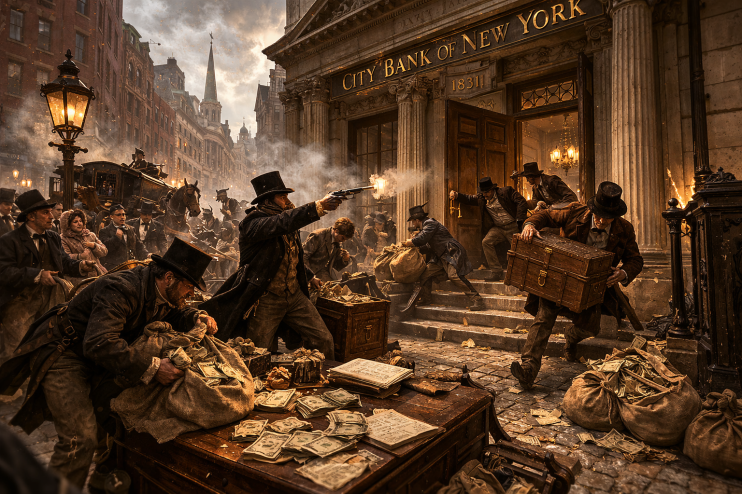
It stands as an archetypal heist: a pair of canny, hardened criminals; a simple but daring plan; a dogged law enforcement official and the tantalising mystery of the missing $63,000. The first bank robbery in America recorded in any detail had set the standard for a whole genre, says Eliot Wilson
Have you ever wondered where the word “heist” comes from? It’s so evocative, suffused with that dangerous and guilty glamour that art has brought to the narrative of crime; a “heist movie” always raises the heartbeat and starts the adrenaline flowing. The best films of the genre are among the best outright: The Italian Job, The Thomas Crown Affair, Heat, Ocean’s Eleven, the inch-perfect Rififi.
The term appears in the 1920s, the decade which epitomised the glamour of lawlessness. A “heister”, meaning a thief, is first found in 1927, dutifully recorded in Dialect Notes Vol. 5 of the American Dialect Society; “heist” is used to mean a robbery in Edward Dean Sullivan’s Chicago Surrenders in 1930. But the derivation is humdrum, seemingly a simple dialectical alteration of “hoist”; “lifting” as a term for stealing goes back at least as far as Shakespeare.
We name things we already see and know. To find perhaps the first recorded bank heist, you must go back a century further, to New York City in 1831. The United States was 55 years old and the 7th President, the military hero Andrew Jackson, was halfway through his first term in office.
New York, booming since the completion of the Erie Canal connecting the Great Lakes to the Atlantic, was home to more than 200,000 people. That made it comfortably America’s biggest city – Baltimore and Philadelphia are both around 80,000 – but modest by international standards. London, Beijing and Paris all had populations above a million, and New York was still in the shade of Edo, St Petersburg, Constantinople, Vienna and Naples. But it was growing fast, and would reach half a million by mid-century then 3.5m by 1900.
The City Bank of New York had been founded in 1812, in response to the expiration of the charter of the Bank of the United States, Alexander Hamilton’s rudimentary attempt at creating something like a national bank. From its handsome granite and limestone premises at 52 Wall Street, City Bank dealt mainly with finance on foreign trade to and from New York. And inevitably it also began to attract the attention of those who regarded purloining the wealth of others as the easiest path to prosperity.
Seasoned criminals
195 years ago today, in the dying hours of Saturday 19 March 1831, two Englishmen entered City Bank using keys made from wax impressions of the doorlock, and secured the doors behind them. They went by many names and aliases, but their identities seem to have been James Honeyman and William J. Murray, seasoned criminals who had spent time at the penal colony of Sydney Cove in New South Wales. Honeyman’s brother-in-law, a locksmith, had made the keys for them.
Once inside the bank, they were in no great hurry. The pair emptied City Bank’s vault and a number of safety deposit boxes and methodically filled several bags with coins, including 398 gold doubloons, and notes worth a total of $245,000 – the equivalent today of over $50m. Once the nightwatchmen went off duty and the sun began to rise, Honeyman and Murray left 52 Wall Street with the bags hidden under their cloaks, and made for Murray’s lodgings to divide their spoils.
Honeyman packed his share into three trunks and took a room in a boarding house under the unoriginal alias of “Jones”. Murray, meanwhile, moved 80 miles south to Philadelphia. At City Bank, suspicion initially fell on the employees, the lack of a forced entry indicating an inside job. The following weekend’s edition of The Saturday Evening Post carried a notice of the heist and offered a reward of $5,000 to help recover the stolen money. But the net was already tightening.
Honeyman’s landlord had become suspicious of his tenant’s manner and the presence of three large trunks, coming to conclude they contained stolen goods. On Saturday 26 March, Honeyman left the boarding house with one trunk, telling the landlord he would return for the other two. The landlord immediately summoned Jacob Hays, since 1802 the High Constable of New York; he was approaching 60 and had such an encyclopaedic knowledge of the city’s criminals and such dogged determination that parents warned misbehaving children, “Old Hays will get you”.
Hays already had his sights on Honeyman. He knew the Englishman had been charged with robbing a Brooklyn bookstore, had attempted to steal money from a steamboat and, it was rumoured, remained a suspect in the robbery of a mail coach in England. Hays and the landlord opened the two remaining trunks, found $185,785 in stolen money, and waited for Honeyman to return. When he did so, three hours later, Hays put him in handcuffs and took him before a judge. He then went to Philadelphia where he apprehended Murray and brought him back to New York.
Honeyman and Murray were each sentenced to five years in the newly opened Sing Sing prison, where absolute silence was enforced by whipping and the prisoners were made to quarry stone. $63,000 of the proceeds from the robbery, including the gold doubloons, was never found, and for a time Hays himself came under suspicion of having appropriated it.
It stands as an archetypal heist: a pair of canny, hardened criminals; a simple but daring plan; a dogged law enforcement official; the morally satisfying conviction and sentencing of the heisters; and the tantalising mystery of the missing $63,000. The first bank robbery in America recorded in any detail had set the standard for a whole genre.
Eliot Wilson is a writer and historian; senior fellow for national security at Coalition for Global Prosperity; contributing editor, Defence on the Brink
#Americas #recorded #bank #heist