
| Updated:
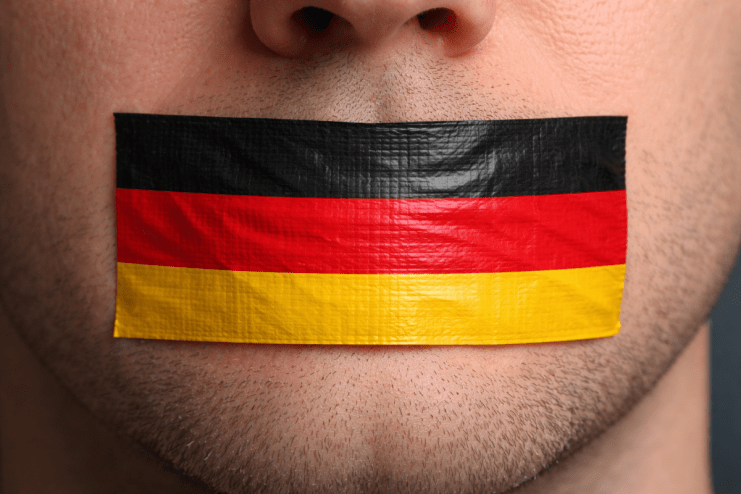
Historian and City AM columnist Rainer Zitelmann finds himself in the crossfire of Germany’s free-speech debate
I will turn 69 in June, and it is the first time in my life that I have come into conflict with the law. At the beginning of February I received a letter from the Berlin police: “Written statement in a criminal proceeding. Allegation: Use of symbols of unconstitutional and terrorist organizations pursuant to Section 86a of the German Criminal Code. Time of the alleged offense: December 11, 2025 at 11:57 a.m. Place of the offense: Internet. Location: X.”
At first I had no idea what this referred to and had to research what I had posted on that date. Then I found my repost (I did not create the image) showing Hitler and Putin. Hitler appears in the picture with a speech bubble saying: “Give me Czechoslovakia and I won’t attack anyone else!” Putin has a speech bubble saying: “Give me Ukraine and I won’t attack anyone else!” Hitler is wearing an armband with a swastika.
I am not particularly fond of Hitler analogies. Perhaps that is also because I spent ten years of my life studying the subject and earned my doctorate with a dissertation on Hitler. From this scholarly perspective, many analogies appear distorted. They often do not fit and serve more to end a discussion than to illuminate it. But since the beginning of the war in Ukraine, parallels in the arguments of Adolf Hitler and Vladimir Putin have also struck me — as well as similarities in the way the West has responded to both dictators. During the Sudeten crisis in 1938, Hitler repeatedly declared that the Sudetenland was his last territorial demand in Europe. Shortly afterward, the Munich Agreement approved the cession of the Sudetenland. But, as is well known, Hitler did not stop there and only a few months later occupied the remaining territories of what had been Czechoslovakia. The similarity between Hitler’s and Putin’s rhetoric has not only been noticed by me, but by many historians, including Anne Applebaum, Timothy Garton Ash, Niall Ferguson and Timothy Snyder.
The basis of the proceedings against me is Section 86a of the German Criminal Code. Section 86a was originally introduced to prevent people from marching through Germany’s streets with swastika flags, shouting “Heil Hitler” and making the so-called Hitler salute — in other words, a law against National Socialist propaganda. Today the provision is being misused and applied against people who are clearly democrats and opponents of extremism.
I am not the only one affected. Alongside me, well-known figures such as the scholar Norbert Bolz and the journalist Jan Fleischhauer have also been targeted. These are people who are moderately conservative or classically liberal; I myself am more libertarian.
Against the right
I do not know who filed the complaint in my case. In the case of Bolz, it was a state-supported reporting portal, the “Meldestelle” Hessen gegen Rechts. I find these “Meldestellen” troubling. The terminology itself illustrates the problem: it is not called a reporting office against “right-wing extremism”, but rather “against the right,” a term broad enough to include democratic conservatives and liberals.
Until a few years ago, attempts to silence controversial views were often associated with what was called “cancel culture.” As that approach has lost some of its effectiveness, critics increasingly see a shift toward legal and administrative pressure.
I made my case public and received a great deal of solidarity — not only in Germany, but from many countries. Scholars such as Steven Pinker of Harvard University wrote to me and made the case public on X. European newspapers such as Neue Zürcher Zeitung from Switzerland and The Times from London reported on it in detail.
But not everyone can defend themselves. Many unknown people are affected. One example is a pensioner whose door was knocked on by police at six in the morning because he had referred to the then Green Minister for Economic Affairs, Robert Habeck, as a “Schwachkopf” (“moron”) in a social media post.
In the case of the pensioner, and in many similar cases, the legal basis is Section 188 of the German Criminal Code. This provision criminalizes insults, defamation, or slander directed against people active in political life. It grants politicians stronger legal protection than ordinary citizens, since identical statements can be punished more severely when directed at someone involved in politics. The provision was significantly tightened in 2021, increasing the maximum penalty to two years in prison and making it easier for prosecutors to pursue such cases.
In recent years the number of investigations has risen sharply, as politicians increasingly report social media posts and comments to the authorities. Several thousand such cases are now recorded every year. At the same time, the German Association of Judges has been warning for some time about the growing strain on the judicial system. By the end of 2025, the number of pending criminal cases had exceeded one million for the first time. The complaint against me therefore fits into a broader pattern: a rising number of reports of so-called hate crime on the internet are entering the judicial system and further increasing its already considerable burden.
Rainer Zitelmann is a historian who has written and edited 31 books that have been translated into 35 languages. In June, his book NEW SPACE CAPITALISM will be published by SKYHORSE PUBLISHING.
#Free #speech #threat #Germany