
| Updated:
In automotive days of old, a mid-life facelift often comprised a set of clear indicator lenses and some extra plastic chrome around the grille. Maybe a standard rear wash/wipe if you were lucky.
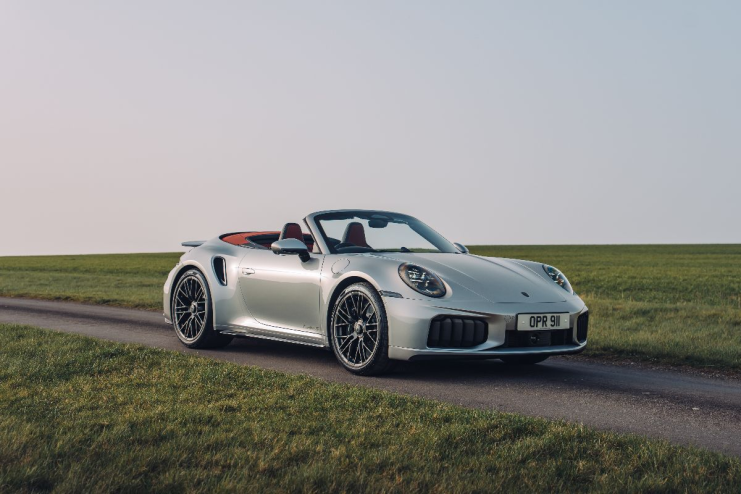
There are no such half-measures here. Despite appearances, the updated 992-generation Porsche 911 Turbo S – known to enthusiasts as the 992.2 – is a substantially new car.
The ‘standard’ Turbo has been quietly phased out, making this 711 horsepower Turbo S the standalone flagship of the 911 range. At £199,100 for the coupe or £10,000 more for the Cabriolet driven here, it’s almost exactly twice the price of a base 911 Carrera.
Can this steroid-pumped Porsche really hold its own against blue-blooded supercars such as the Aston Martin Vantage and McLaren Artura? I had the arduous task of finding out…
A Meister at work
The new Turbo S has more power than its 992.1 predecessor, so it’s faster in a straight line and around a lap of the Nürburgring. No surprises there. Much more significant is how this added schnell is achieved: via a T-Hybrid system similar to that used in the latest 911 GTS.
Don’t panic, there is still a flat-six behind the Porsche’s back axle, but it’s been downsized from 3.8 to 3.6 litres and is supplemented by a 1.9kWh battery and a 60kW electric motor. The latter is integrated into the PDK automatic transmission and contributes 82hp and 139lb ft of torque.
While the 911 GTS uses a single electric turbocharger, the big-T-Turbo has two smaller eTurbos, which spin at up to 145,000rpm to eliminate lag. They also act as generators for the hybrid battery when off-boost.
It all adds up to some headline-grabbing numbers: 711hp, 590lb ft, 0-62mph in 2.5 seconds (2.6sec for the Cabriolet) and a 200mph top speed. With legendary Porsche test driver Jörg Bergmeister at the wheel, that Nordschleife lap-time is 7min 3.92sec – a stonking 14 seconds quicker than the outgoing car.
Fighting the forces of physics
The trade-off for the T-Hybrid tech is 85kg of additional weight, bringing the Turbo S coupe to 1,725kg and the Cabriolet to a substantial 1,810kg. For comparison, the latest Porsche 911 GT3 has a standard DIN weight of 1,439kg.
However, the Turbo S has a secret weapon in its snappily named ehPDCC, or electro hydraulic Porsche Dynamic Chassis Control. This harnesses the new 400V hybrid architecture to improve ride comfort and reduce body-roll. The system reacts in 50-200 milliseconds and limits lean to half a degree when cornering. It powers the optional front axle lift, too.
Elsewhere, you’ll find larger carbon-ceramic brakes – enormous 420mm discs with 10-piston calipers at the front – and slightly wider 325-section rear tyres. The Turbo’s bespoke centre-lock wheels measure 20 inches at the front and 21 inches at the rear.
Open for business
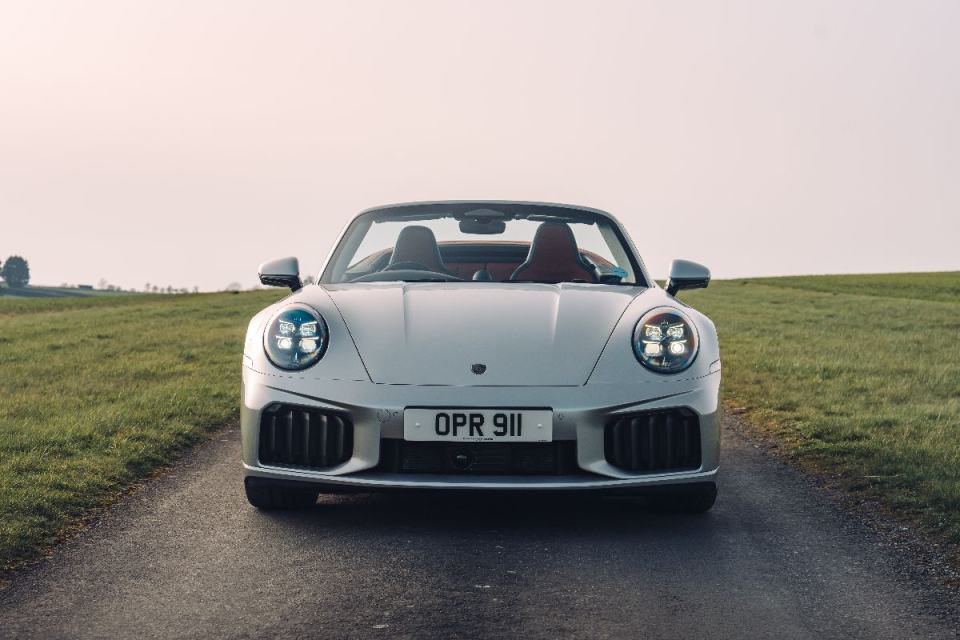
Externally, the easiest way to spot a 992.2 Turbo S is by the GTS-styling vertical vanes in its front bumper. These can swing open to allow more air into the radiators, or close in the rain to prevent the brakes from getting wet. Combined with adjustable flaps underneath the car and an active rear spoiler, they help reduce aerodynamic drag by 10 percent.
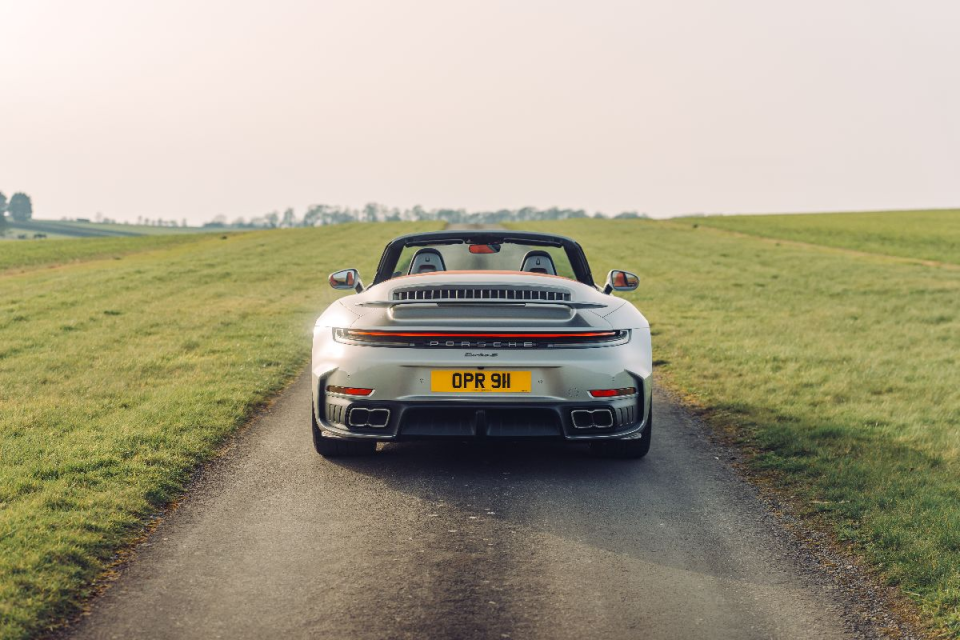
I love the Turbo’s muscular haunches, but its rear end looks a bit over-wrought to me, particularly the blocky titanium tailpipes and jagged diffuser. I also recall fondly the days when you could actually see a 911’s engine. All you get here is a black plastic ‘servicing panel’ for topping up the oil and water.
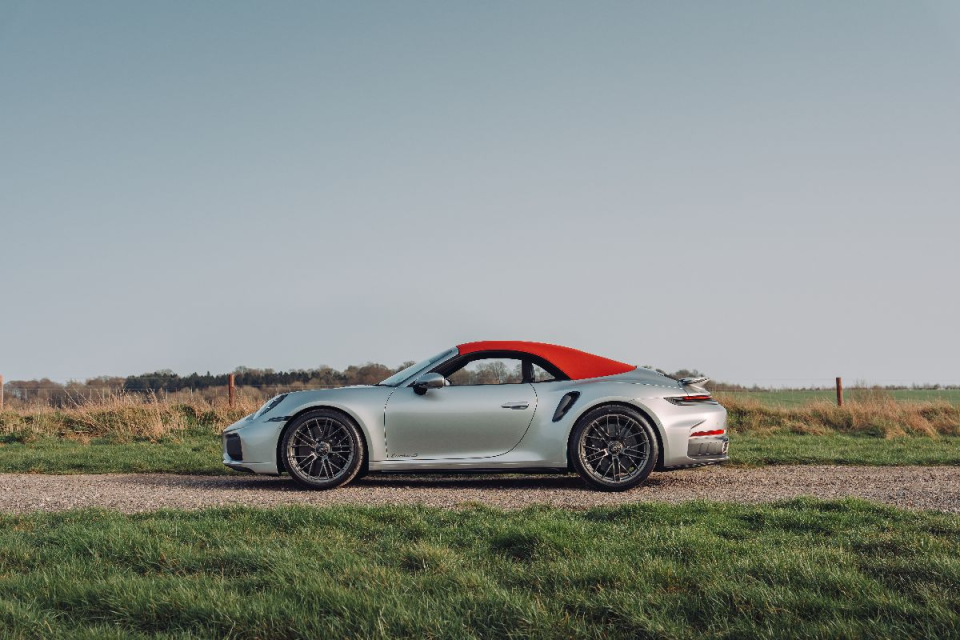
The Cabriolet’s electrically folding soft-top has a similarly sleek profile to the coupe’s roof, although it loses the elegant curve of the rear side windows. Porsche expects this version to account for 30 percent of 992.2 Turbo S sales.
Inside the Porsche 911 Turbo S
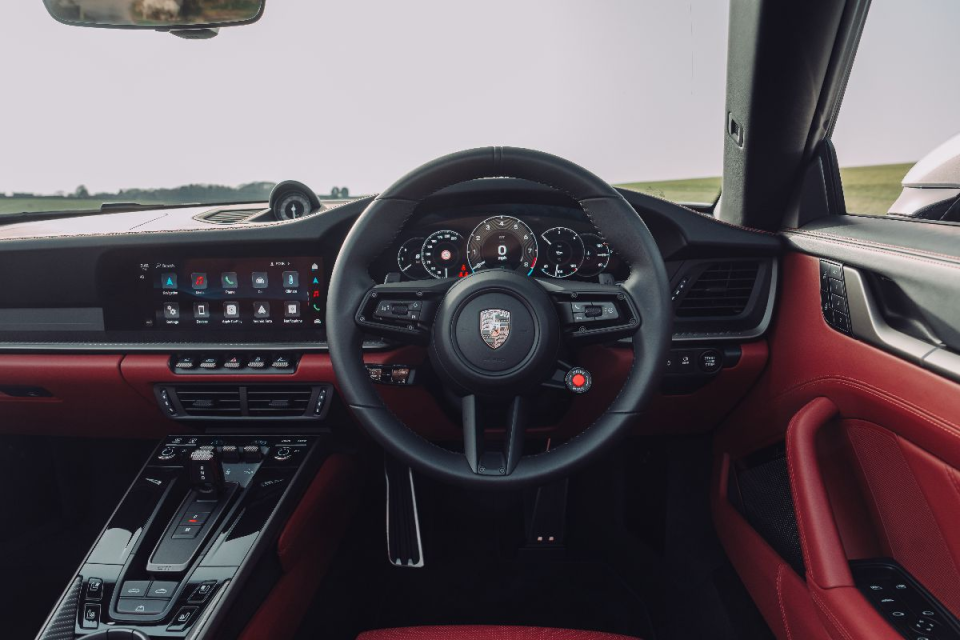
While rear seats are a no-cost option in the coupe, the Cabriolet gets them as standard. Frankly, near-vertical backrests and Lilliputian levels of legroom mean they are best treated as extra luggage space, supplementing the 911’s compact 128-litre ‘frunk’.
Elsewhere, the interior of the 992.2 is little changed – and that’s no bad thing. Quality is suitably Germanic, the driving position is excellent and the central touchscreen is easy to operate. You can also set a shortcut to switch off the speed limit bongs with one button-press.
The most obvious difference is a digital rev counter, which replaces the analogue dial used previously. You’ll also notice the steering wheel badge and window surrounds in ‘Turbonite’ – a dark metallic finish reserved for Porsche’s Turbo models. Options on my test car (pictured) included Bordeaux Red leather trim (£513), adaptive cruise control (£1,468) and a high-end Burmester audio system (£2,752).
Like Cabriolet off a shovel
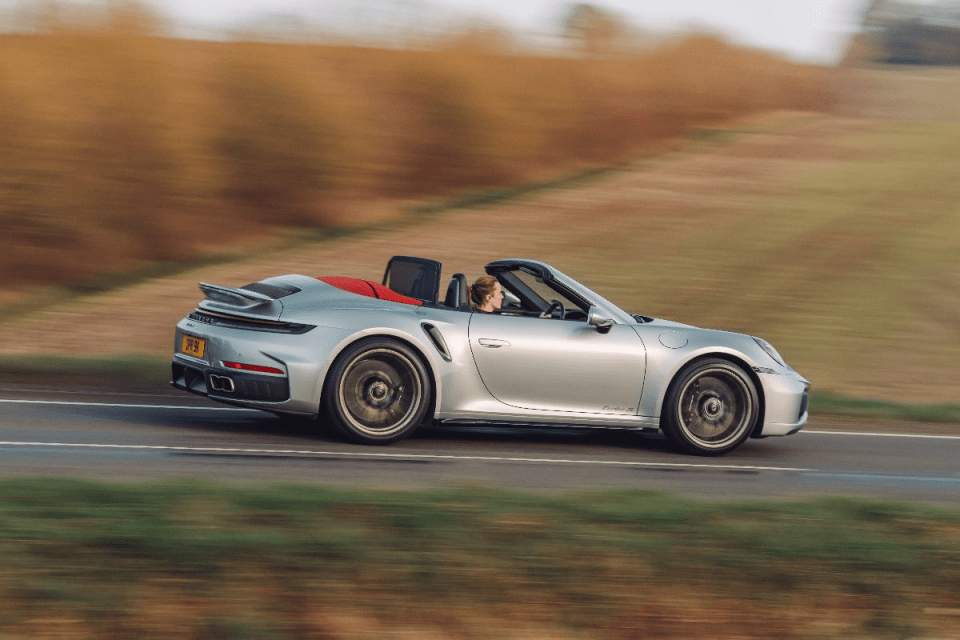
So how does it drive? ‘Quickly’ is the short answer. ‘Like something off a shovel’ is a longer one. Yet it’s the ever-ready response of the new T-Hybrid system, rather than the 911’s raw speed, that really left me reeling.
Given the original (930) 911 Turbo was famous for its waaaaait-for-it turbo lag, the contrast here couldn’t be greater. The electric eTurbos mean the throttle reacts with the wham-bam immediacy of a powerful EV like a Porsche Taycan. And the acceleration just keeps building from there.
To illustrate my point, consider the power curve, which is flat enough to rest a spirit level on: the full 711 horses are available from 2,000rpm all the way to 7,000rpm. Factor in the PDK dual-clutch transmission, which blams through its eight ratios without pausing for breath, and a saintly sense of restraint is required on any public road.
Unlike many hybrids, the 911 Turbo S can’t travel any distance on electric power only; the role of its electric hardware is very much to boost performance. I only wish it made a better noise. The hard-edged snarl of the water-cooled six is strangled by EU regulations, and the way it’s augmented inside the car sounds a bit synthetic.
The Porsche 911 is a car of immense ability
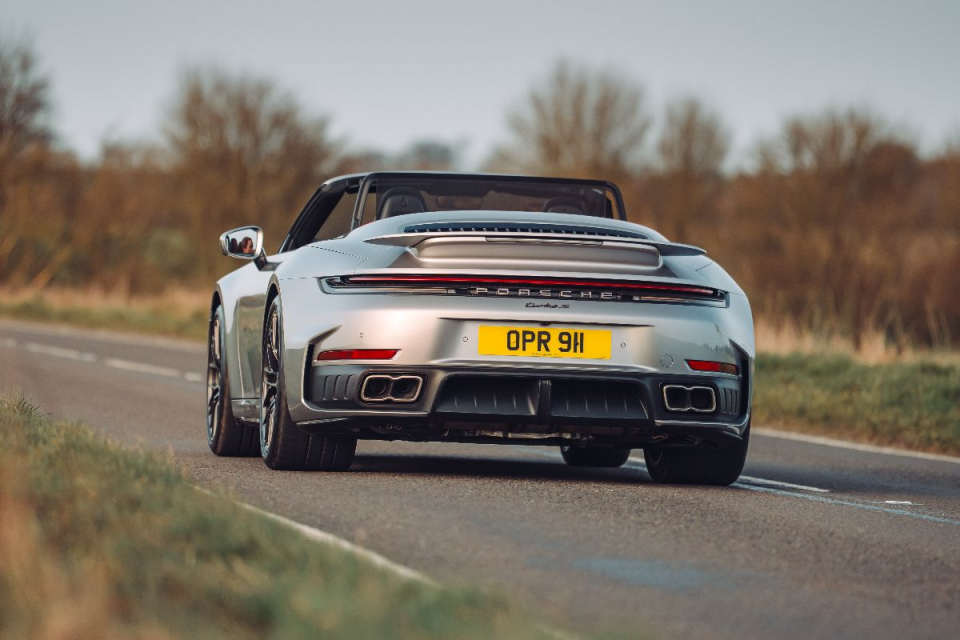
As for corners, the 911 Turbo S shrugs them off with the nonchalance of Jörg Bergmeister being asked to drive another lap of the Nürburgring. The ehPDCC suspension tackles G-forces head-on, serving up iron-fisted body control that almost makes all 1,810 kilograms evaporate. Backed up by four-wheel drive traction and rear-axle steering, the 911’s balance feels utterly neutral – a far cry from the ‘widowmaker’ 930 that started it all.
Porsche’s brakes, as ever, feel reassuringly over-engineered and should prove fade-free if you ever take your Turbo S on-track. The steering isn’t the last word in feedback, but it’s quick and precise, helping you place the car accurately on the road. On country lanes you’re always aware of those fulsome hips, but the same applies to any modern supercar.
And make no mistake, the Turbo S is a supercar. Its speed and dynamic potential go so far beyond what is possible (or more correctly, what is legal) on a public road, it feels like turning up to a soap box derby in a Formula 1 car. Nonetheless, this is still a vehicle you could drive every day, as comfortable pottering around town as it is blasting flat-out along the Döttinger Höhe. No Porsche 911 has ever boasted such a breadth of ability.
Verdict: Porsche 911 Turbo S
Does that make the 992.2 Turbo S the best new Porsche 911 of all? Well, if you’ll allow me to park my posterior on the fence… yes and no. If you want visceral driving excitement, the GT3 and more extreme GT3 RS are still the ones to have. Yes, both are nearly 200 horsepower shy of the car tested here, but a naturally aspirated flat-six that howls to 9,000rpm provides bountiful compensation. You can also order the GT3 with a manual gearbox, which is not even an option on the Turbo S.
Then there’s that old car review cliché about the Carrera being the only 911 you really need. That’s still true, and the 394hp base model is a polished all-rounder that won’t leave you feeling short-changed. For a few dollars more, there’s also the sportier Carrera T with three pedals and a stick.
Then again, nobody really needs a Porsche 911, and given an appropriately big budget I’d certainly plump for the Turbo S. It’s perhaps the only supercar you could realistically contemplate using as a daily driver – and that alone makes it something special.
Porsche is living through difficult times, with the likes of US trade tariffs, slower sales in China and a U-turn on the fully electric Boxster/Cayman all eating into the company’s bottom line. Soon, like Volkswagen after the Dieselgate scandal, it will be forced to cut costs and the engineering budget afforded to its crown jewel, the 911, could be diminished.
All this potentially makes the new Turbo S one of the highest water marks in the history of the 911. People frequently say that ‘peak car’ has already been and gone, but in this case I’m not so sure.
Tim Pitt writes for Motoring Research
Porsche 911 Turbo S Cabriolet
PRICE: £209,100
POWER: 710hp
TORQUE: 590lb ft
0-62MPH: 2.6 seconds
TOP SPEED: 200mph
FUEL ECONOMY: 24.0mpg
CO2 EMISSIONS: 266g/km
#Porsche #Turbo #Cabriolet #review #Meet #boss