
| Updated:
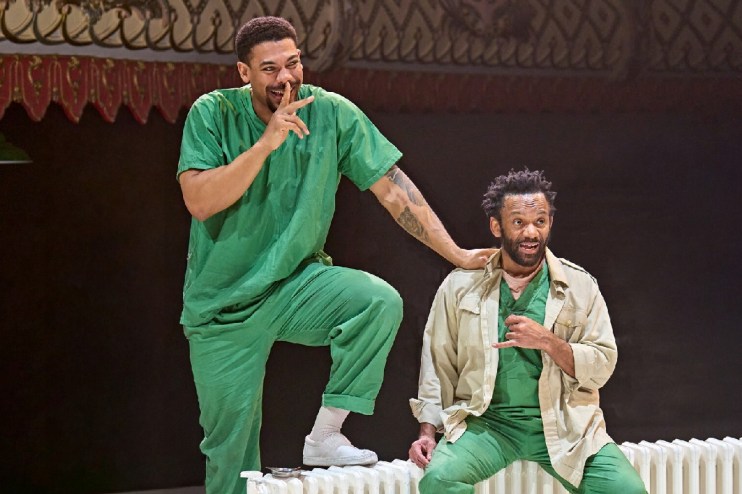
From his searing take on Othello at the National Theatre to his superlative Death of England cycle, Clint Dyer is one of the most distinctive voices in British theatre, deftly exploring and unpacking contemporary black culture. So it is perhaps unsurprising that the patients in his version of One Flew Over the Cuckoo’s Nest are African Americans. But this isn’t just an interesting ‘what if?’ – it’s a depressingly accurate portrayal of US incarceration, in which almost 70 per cent of prison inmates and more than half of psychiatric in-patients are not white.
For the uninitiated, One Flew Over the Cuckoo’s Nest tells the story of Randle P McMurphy, a serial criminal who thinks opting for a spell in a psych ward will be easier than enduring the work farm. He lights a fire under his fellow inmates, demonstrating that it’s often the system, rather than the people in it, who are at fault. But the system tends to have the last word…
Play Video
Bringing in the hulking Aaron Pierre as McMurphy is inspired casting. He’s more likeable than the version played by Jack Nicholson in the 1975 film and perhaps more obviously mentally ill, too. He brings a punchy, confrontational energy to the asylum but he clearly struggles to function within its confines, visibly trying – eyes blinking, muscles tensing – to roll with its frequent punches.
A sympathetic One Flew Over the Cuckoo’s Nest Adaptation
Apart from switching the race of his characters, this is a sympathetic adaptation, maintaining the 1950s setting, right down to the bow-ties on the orderlies and the crisp little caps on the nurses. Dyer said he wanted to adapt the book rather than the movie but his play feels like a blend of the two, still told predominantly from the perspective of McMurphy (the novel is seen through the eyes of the apparently deaf-mute Chief Bromden) but incorporating the source material’s surreal dream/psychosis sequences. In these Bromden hallucinates feverish apparitions of his father, a Native American chief who was swindled out of his ancestral land and ended up drinking himself to death. These visions play out against a backdrop of strobing lights and projected montages of blinking eyes and scorched land.
On reflection, I think film director Miloš Forman may have had the right idea: these are the weakest elements of an otherwise blistering production (I was also non-plussed by the mardi gras dancers who cavort across the stage during the opening moments).
Wonderful acting at the Old Vic
But this is nit-picking: the acting is brilliant, not only in the lead role but throughout the cast. Kedar Williams-Stirling is exceptional as the fragile, stuttering Billy Bibbit, really selling his longing and vulnerability. Jason Pennycooke is utterly believable as Martini, all physical ticks and chaotic energy. There is a little suspension of disbelief when it comes to Bromden, played by Arthur Boan, who may be 6’4” but is hardly a physical match for Pierre, who looks like he could lift the electrical power bank – which replaces the film’s water fountain – in one bicep curl.
And then there is Olivia Williams as the dreaded Nurse Ratched, who drip-feeds her transformation from strict matriarch to full-blown figurehead for institutional spite. The performances play wonderfully off each other, feeding on the general sense of mania; rare are the moments when this stage approaches a state of stillness.
Adapting such a beloved text can be fraught: when you get it right, such as Sean Foley’s brilliant version of Dr Strangelove, the combination of nostalgia and reinvention can be a potent drug. But when you slip up (I’m looking at you, Cynthia Erivo’s Dracula), you’ll be judged not only on your own lack of merit, but the weight of history, too. One Flew Over the Cuckoo’s Nest falls firmly in the first category.
#Flew #Cuckoos #Nest #Vic #blistering #revival