
Tiger Brands has agreed to the disposal of its iconic Beacon Easter eggs and chocolate slabs businesses, as well as the Beacon brand itself, as it continues a more than 24-month long process under CEO Tjaart Kruger to trim its portfolio.
It would not disclose the buyer, but has booked an impairment of R92 million on the sale.
Read: Tiger Brands sells its iconic head office
It is also separately selling the Durban factory where these products are currently being made, and expects to recognise a profit on that disposal which will offset the impairment.
Ongoing portfolio shake-up
Beacon is a 95-year-old brand and Tiger acquired a 50% stake in 1990 before buying it outright in 1998. Out of this grew Maynards, mmmMallows, Liquorice Allsorts and Sparkles – all of which have arguably become bigger brands than Beacon itself.
While likely not loss-making, the investment required to get the slabs production facilities up to scratch is now just too costly to justify.
Kruger admitted last year that the business had not upgraded its chocolate manufacturing equipment in over 30 years. This has seen it trail market leaders Cadbury (Mondelēz) and Nestlé by a long way.
The Easter egg (and associated product) business is completely seasonal, which explains Tiger Brands’s decision.
The group will retain the TV Bar, Nosh, Wonder Bar and Jungle energy bar, as well as the chocolate variants of Black Cat and Jelly Tots. “In addition to being profitable”, it says, these are “a strategic enabler” of its “snackification” growth platform.
ADVERTISEMENT
CONTINUE READING BELOW
CFO Thushen Govender says “Jungle Bar is now in the top three countlines in the country”.
“It’s performing exceptionally well, and that’s also helping the profit mix.”
Durban consolidation adds complexity
Along with the disposal, the group is consolidating its three manufacturing sites in its snacks, treats and beverages division in Durban into one.
This is an enormously complicated project, as its busy doing this while disposing of a part of the business and still manufacturing its jellies, candy and mallows.
This unit accounted for 18% of its revenue in the first half – almost the same as its grains business (trading in a period of deflation) – but at a better margin and profit (R505 million versus R441 million).
Kruger’s strategy has been disarmingly simple: rationalise units and products that don’t move the needle and focus on its mega brands.
In the past two-plus years, it has disposed of its baby wellbeing division, non-core personal care brands (Bio Classic, Bio Crystal, Kair, Black Silk, Fiesta and Eulactol), its Randfontein maize and wheat milling unit, the Langeberg & Ashton Foods (canned fruit) operation, as well as Chilean associate Carozzi and Chococam.
Read:
Tiger Brands sells fruit business for R1
New era for Langeberg Foods after Tiger Brands exit
Tiger Brands confirms plan to sell loss-making fruit canning plant
Tiger Brands confirms plan to sell loss-making fruit canning plant
In the last six months, it has also sold the niche Game and Monis (grape juice) brands, on which it booked a profit of R6 million.
Simplifying the organisation
Kruger says the current leadership team has been focused on simplifying the organisation, and the “big challenge now is to make sure we don’t lose control the other way again” (in other words, avoiding the mistakes made over the past two decades).
ADVERTISEMENT:
CONTINUE READING BELOW
“We are there and we must make sure that we focus on this organisation as a simplified business where we focus on big things and not fiddle around with stuff that doesn’t make a difference.”
Following its disposals, it has 15 major (mega) brands left, including Albany, Tastic, Koo, All Gold and Oros. Of these, 11 are ranked first in their category in terms of brand equity, with one (Crosse & Blackwell) in second place.
The mayonnaise brand is already back in first place in terms of market share, and Kruger says it will be a matter of time before it attains first place in term of equity. All but three are the largest in terms of volume.
Listen/read: Tiger Brands ‘getting better and better’
He reiterates a comment he made previously about its brands actually belonging to the consumer. “It’s not ours, it’s just our job to make sure they are relevant to the consumer.”
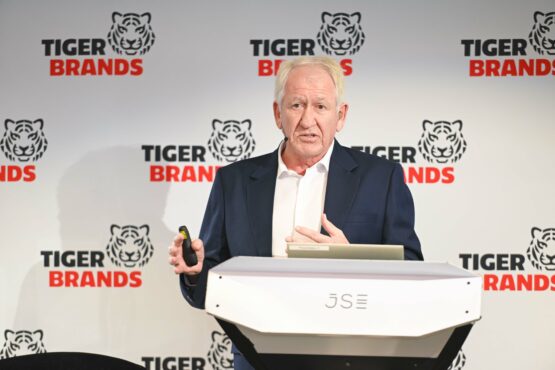
CEO Tjaart Kruger is eyeing ‘a simplified business where we focus on big things’. Image: Supplied
A unit previously up for sale – King Foods, which manufactures sorghum-based products in Potchefstroom – has since been turned around and is no longer on the block.
The group says offers received for the business did not meet its “value realisation hurdles”.
Tiger Brands share price
#Chocolate #wars #Tiger #Brands #sells #Easter #eggs #slabs #Beacon