
The Government remains alert to revenue risks within the medium-term fiscal framework, although revenue collections performed better than projected in February this year.
Tax revenue for 2026/27 has been revised upwards by more than R17 billion to R2.14 trillion, with main budget revenue expected to increase by more than R70 billion over the next two years.
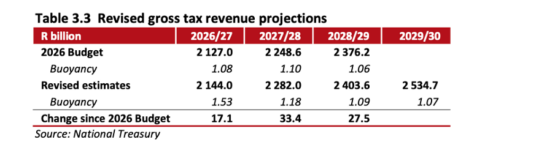
Tax collections are expected to remain “buoyant” over the medium term, with tax revenue forecast to grow faster than the economy.
Areas of concern regarding the medium-term framework include weaker-than-expected corporate profits, lower commodity prices, rising unemployment, and reduced household consumption.
ADVERTISEMENT
CONTINUE READING BELOW
A growth in the tax base could provide an upside as would stronger economic growth.
Nevertheless, a relatively small pool of taxpayers continues to bear the brunt of the tax burden, which currently stands at close to 27% of gross domestic product (GDP), as measured by the tax-to-GDP ratio.
The Medium-Term Budget Policy Statement (MTBPS) highlights the impact of escalating geopolitical conflicts and disruptions to global trade and energy markets. This could lead to weaker global activity, higher energy prices, and renewed inflationary pressure.
More grant beneficiaries
“The main expenditure risks relate to natural disasters, the outcome of the legal dispute regarding the social relief of distress grant, student financial aid and compensation of employees.”
The MTBPS refers to legal challenges to the regulations governing the Social Relief of Distress Grant. The High Court found that the provisions relating to the means-test threshold, grant value, definition of income, and income-verification arrangements were invalid.
Read:
Explosive court ruling on SRD grant
National Treasury grilled by judges on SRD grant
Government appealed the judgment, and the Supreme Court of Appeal heard the matter in August this year. However, judgment is still pending. The fiscal impact will depend on the outcome of the litigation and the policy response.
ADVERTISEMENT:
CONTINUE READING BELOW
Preliminary estimates suggest that it could add between three million and 13 million eligible beneficiaries, raising the annual funding requirement from about R36 billion to R74 billion.
Government’s wage bill continues to be a risk.
Although the current public service wage agreement covers the next financial year, there are indications that the wage bill, currently around 17% of GDP, could exceed the amount provided for in the fiscal framework.
Read: Taxpayers’ wallets not enough to cover public servants’ paycheques
“Government manages this risk through workforce planning and expenditure ceilings, but to be effective these require the future wage agreements and employment decisions to remain consistent with the fiscal framework.”
#Risks #looming #betterthanexpected #tax #collections