
Since the record cyber theft against the world’s largest crypto exchange last week, traders bracing for the worst have instead watched Bitcoin pull off an unexpected feat: defying gravity.
The original cryptocurrency rose about 1% Monday, trading around $78 300 at 1 p.m. in Singapore. It’s down roughly 4% from Thursday’s high before Binance disclosed a hack that would ultimately see $6.3 billion of user funds siphoned off. The token’s resilience has widely been attributed to the swift response from Binance, which promised from the start to cover all losses.
“Bitcoin holding up over the weekend is essentially a vote of confidence in Binance’s statements,” said Caroline Mauron, co-founder of Orbit Markets. “The market is clearly convinced that Binance has enough funds to cover the losses.”
Bitcoin was already under pressure last week from a selloff in risk assets, so its relative buoyancy underscores how differently traders are treating the incident than during the last major calamity to strike one of the largest crypto exchanges. During the 2022 collapse of then second-largest exchange FTX, Bitcoin fell 19% over three days as the company run by former billionaire Sam Bankman-Fried went from a liquidity crunch to bankruptcy.
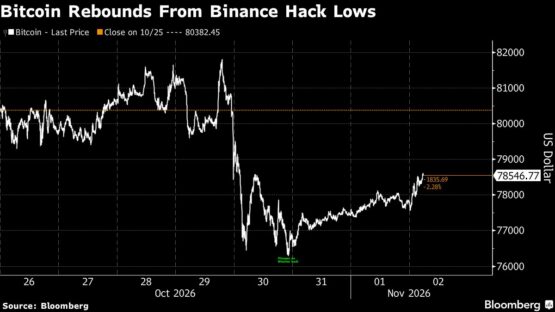
Sean McNulty, a derivatives trader at market maker AQC Tech, said one reason for Bitcoin holding up better this time around is that Binance is buying the token to make users whole. But underlying sentiment remains uneasy, he said.
ADVERTISEMENT
CONTINUE READING BELOW
“People see this as the tip of the iceberg and expect more hacks to happen given the AI capabilities,” said McNulty, referring to the use of artificial intelligence in cyberattacks this year. “If Binance, the world’s largest exchange, can be hacked then no one is safe.”
In a sign of underlying nerves, there’s growing demand for near-term protection against a Bitcoin decline. The one-day 25-delta put skew, a measure of how much more traders are paying to protect against a sizeable drop than to bet on a comparable rise, climbed about 1 percentage point in 24 hours to 6.37 points, according to data based on options on crypto derivatives platform Deribit.
Kelly Ye, head of research at the trading firm Talos, said traders are responding differently to the hack compared with FTX’s collapse, which involved fraud.
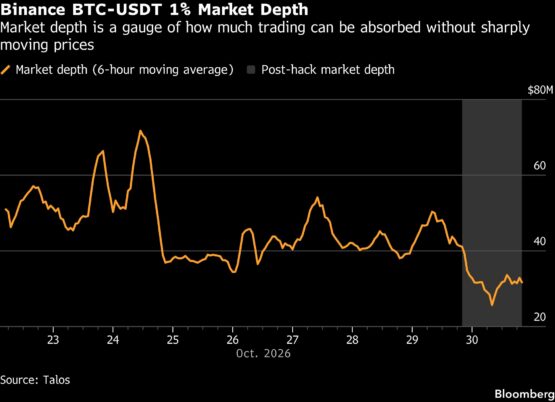
“The market treated this as an operational shock, not a systemic one,” Ye said, noting that order book depth on Binance dropped 25% to 30%, but that buyers returned within hours. “That’s a very different picture from 2022, when confidence drained out of the whole market.”
The greater near-term impact on crypto markets could come from the US midterm elections on Tuesday. A change in party control of Congress “could have meaningful implications for how crypto market structure legislation moves forward,” said Jeff Ko, chief analyst at ViaBTC.
ADVERTISEMENT:
CONTINUE READING BELOW
Before last week, the largest crypto-related hack was in 2025 on the exchange Bybit, which lost roughly $1.5 billion. The Federal Bureau of Investigation linked both the Binance and Bybit breaches to the North Korean hacking group TraderTraitor.
As with Binance, the Bybit hack initially had a relatively muted impact on Bitcoin. Losses mounted in the days that followed, however, leaving the cryptocurrency about 14% lower a week after the Feb. 21 attack.
With the latest hack, Ye said traders best positioned to identify the market disruption as it happened had spread their exposure across multiple exchanges.
“For institutions, the lesson is simple: no single venue is a safe place to hold risk or to read prices,” she said.
© 2026 Bloomberg
#Bitcoins #resilience #Binance #hack #masks #market #jitters