
South Africans are notoriously demanding of their vehicles. We want the comfort of a luxury saloon, the practicality of a delivery truck and the off-road ability of a mountain goat. Preferably without having to visit the petrol station too often.
But could electrification finally make the all-rounder possible?
That question emerged during a recent visit to China, where Jetour, part of Chery Group, demonstrated how hybrid powertrains and intelligent technology are expanding the capabilities of off-road vehicles. And South African motorists may not have to wait too long to experience them.
Jetour’s engineering team confirmed that its much-anticipated F700 pickup and G700 luxury SUV models are expected to enter South Africa in the third quarter of 2027.
Both models are undergoing right-hand-drive engineering adaptation, while local homologation has yet to commence. Their final South African specifications, therefore, remain undetermined.
Beyond fuel savings
For South Africans, electrification is often viewed through the lens of fuel economy. With volatile petrol prices and long travelling distances, reducing fuel consumption is becoming a necessity. Yet fully electric vehicles face limitations in remote areas where charging infrastructure remains scarce.
Plug-in hybrids offer a middle ground, combining electric propulsion with a combustion engine without making long-distance travel dependent on charging stations. Jetour’s F700 and G700 take this further, using electrification to enhance performance, comfort and versatility.
The manufacturer’s engineering team confirmed that current left-hand-drive configurations offer combined output of up to 665kW and 1 135Nm, alongside a 34.13kWh battery, and claimed combined driving range exceeding 1 000km.
But the more interesting development may not be how far these vehicles travel. It may be what they can do once they arrive.
During an exclusive conversation inside the F700 in China, Jetour International president Ke Chuandeng described the vehicle’s battery as something more than an energy source for driving.
“This is not only a car, it’s a power station,” he remarked.
Taking electricity into the wilderness
For South Africans travelling to remote campsites, farms or areas without reliable electricity, this introduces compelling possibilities. Jetour Engineering confirmed that existing international configurations support vehicle-to-load (V2L) power discharge of up to 6.6kW.
During the manufacturer’s Global Technology Experience Day, vehicles demonstrated this capability by powering outdoor equipment directly. The same technology can support refrigeration, lighting, cooking appliances and power tools, reducing dependence on separate generators.
Suddenly, the question is no longer whether the bakkie can get you to the campsite, but whether it can keep the coffee machine running once you’re there. For some South Africans, that might be the more important test.
Ke also explained that the F700 can operate its air conditioning without continuously running its combustion engine, allowing occupants to rest inside overnight.
For farmers and contractors working away from established infrastructure, external power offers possibilities beyond recreation.
Of course, usefulness depends on available battery charge, appliance demand and the energy reserved for driving. Nevertheless, a bakkie capable of carrying equipment is useful. One capable of powering that equipment offers an entirely different proposition.

Jetour International president Ke Chuandeng. Image: Supplied
Could your vehicle become an energy asset?
The Chery Group is exploring applications beyond powering appliances. At its Global Innovation Conference in Wuhu, the manufacturer showcased vehicle-to-grid technology alongside integrated solar, battery-storage and charging systems.
Vehicle-to-grid technology allows compatible vehicles to return electricity to an external network, potentially enabling owners to charge when tariffs are low and export power when prices rise. Ke discussed this possibility during our conversation, describing how differences between overnight and daytime electricity tariffs could create opportunities in China.
For South Africa, where households and businesses increasingly invest in solar generation and battery storage, the prospect is particularly interesting.
A vehicle could eventually complement domestic energy systems, providing backup electricity or participating in more sophisticated energy-management arrangements.
However, Jetour Engineering confirmed that vehicle-to-home and vehicle-to-grid capabilities for South African models remain subject to future engineering and regulatory decisions. The existing V2L capability should therefore not be confused with a promise that local owners will be able to sell electricity back to the grid just yet.
Making off-roading more accessible
Electrification is only part of broader Chery Group’s technological ambitions. Its Global Innovation Conference also showcased developments in artificial intelligence, semiconductor technology, robotics and intelligent mobility.
In a separate conversation, Ke explained that Jetour draws on Chery’s technological resources while developing its own off-road capabilities, including XWD intelligent four-wheel drive and the GAIA all-terrain architecture.
Experienced off-road drivers understand the importance of managing traction, differential locks, power delivery and momentum across different surfaces. Jetour’s XWD system simplifies many of these decisions through selectable terrain modes and intelligent adjustments to the vehicle’s response.
Depending on configuration, the technology incorporates front and rear differential locks, an electronically simulated central lock, and specialised functions including Tank Turn, Crawl Mode and Wading Mode.
Purists might argue that choosing the correct differential lock is part of the adventure. The rest of us may be perfectly happy letting the vehicle do the thinking while we concentrate on avoiding the nearest tree.
GAIA integrates the hybrid powertrain, chassis and suspension systems to balance off-road capability with passenger comfort.
The ambition is to make exploration less intimidating for inexperienced drivers without compromising the capabilities that enthusiasts value. Technology cannot replace sound judgement, but it can make challenging terrain considerably more approachable.
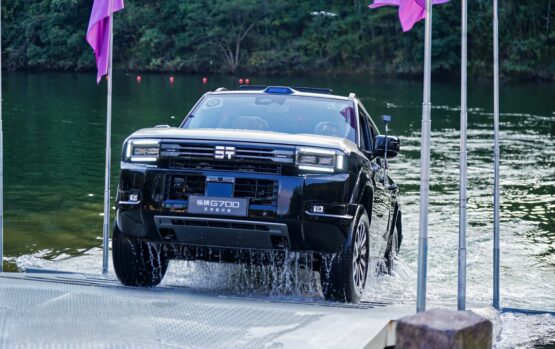
Jetour’s G700 luxury SUV. Image: Supplied
Beyond the vehicle
Jetour’s Travel+ philosophy extends this thinking beyond driving. The manufacturer has developed travel-oriented accessories, including onboard refrigeration, rooftop camping equipment and adaptable storage solutions.
Satellite communication is another interesting development. While seated inside the F700, Ke highlighted the vehicle’s satellite communication technology, which could provide connectivity beyond the reach of conventional mobile networks.
For motorists travelling through remote wilderness areas, the ability to call for assistance without cellular coverage could provide valuable reassurance.
Jetour has also explored drone integration as part of its travel ecosystem, potentially allowing travellers to survey unfamiliar terrain from above. Availability of such features in South Africa remains subject to local requirements and product decisions.
The broader message is that manufacturers are increasingly considering what motorists want to do at their destinations, rather than simply getting them there.
What South Africans can expect
The Jetour Engineering team provided useful reference figures for what their flagship vehicles currently offer the market internationally:
|
Jetour F700 and G700 International specifications |
|
| Specification | Current LHD reference |
| Expected SA introduction | Q3 2027 |
| Combined power | Up to 665 kW |
| Combined torque | Up to 1 135 Nm |
| Battery | 34.13 kWh LFP |
| Electric-only range | Approximately 100-110km |
| Combined range | Over 1 000km |
| External power output | Up to 6.6kW V2L |
| Wading depth | 900mm |
| Ground clearance | F700: 220mm; G700: 230mm |
| Maximum towing | F700: up to 3 500kg; G700: up to 2 500kg |
| F700 payload | Up to 880kg |
Source: Jetour Engineering, in response to questions submitted for this article. Figures refer to current left-hand-drive international configurations and may vary by model or trim. South African right-hand-drive specifications, including certified towing and payload ratings, are not yet finalised.
The figures are promising, but buyers will still want answers about fuel consumption, safety, reliability, after-sales support, and long-term ownership costs. Those fundamentals remain essential, regardless of how sophisticated the technology becomes.
Rethinking the all-rounder
There is something refreshing about a manufacturer approaching electrification as an opportunity to expand a vehicle’s usefulness rather than simply reduce fuel consumption.
With the F700 and G700, Jetour is demonstrating how hybrid powertrains, intelligent driving systems and integrated energy storage can complement traditional off-road strengths.
Perhaps the ultimate measure of a modern adventure vehicle will no longer be how far it takes you from civilisation, but how much civilisation it can bring along.
For South African motorists, the expected 2027 arrival provides something tangible to look forward to.
The next generation of off-road vehicles may no longer be judged solely by how much they carry, how far they travel or which obstacles they overcome.
Increasingly, their value may lie in what they enable people to do once the journey ends.
Brought to you by Jetour.
Moneyweb does not endorse any product or service being advertised in sponsored articles on our platform.
#Unplugging #city #fuel #tank