
| Updated:
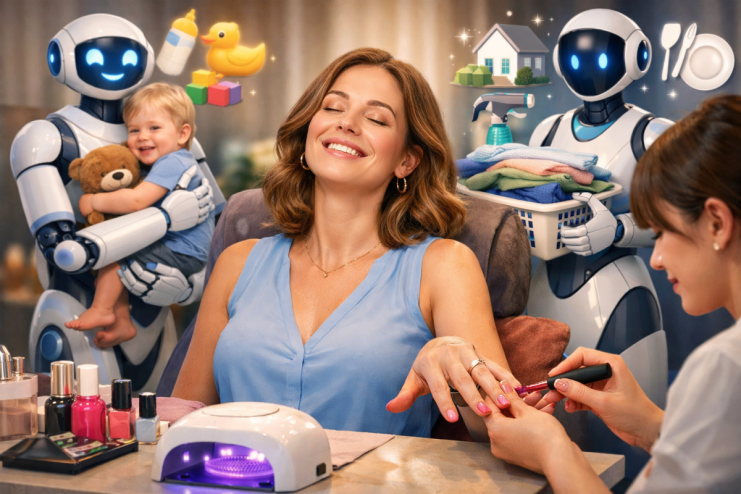
Large language models and agentic AI are exceptionally good at precisely the kind of labour that women have been doing for free for decades. So could technology be an unlikely source of female liberation? Asks Eliza Filby
Have you heard of the so-called pink tax? It’s the rather cringe name given to the added cost of being female, from sanitary products to haircuts. But there’s a more pernicious price women pay: our time.
Think of the extra time it takes to get “work ready”: hair, make-up, outfit. Reject those standards if you will, but there’s no way a female politician or professional could get away with a Boris Johnson-level of dishevelled nonchalance. I know one lawyer who has started taking client meetings at the nail bar (somewhere many of her female clients are already going) which boosts attendance, saves time and gets business done all at the same time. It’s arguably more productive and cheaper than a lunch.
Then there is the time spent managing domesticity and childrearing. All evidence points to the fact that despite fathers stepping up on the time front, women are still carrying the mental load of parenting. The running to-do list: the school Whatsapp group, the birthday party RSVPs, the holiday club booking, the constant invisible labour that goes well beyond bath and bedtime.
And then there is the time tax at work. Long gone are the days when an army of female typists handled correspondence while devoted PAs were at individual executive’s disposal. The typing pool disappeared and professionals have increasingly become their own secretary.
The last 30 years (to say nothing of the last 12 months) have seen tech put in place of people, and increasingly it’s replacing the individual in charge of that tech. Professionals now do their own admin, and it is often women who are the most diligent and pride themselves on a clean inbox. I know one consultant who doesn’t use the office PA because the PA is shared across five partners, is remote in India, and doesn’t understand her home obligations, especially childcare and eldercare responsibilities. So she does all her own administration in the evenings on top of her actual job.
In every organisation there is what I call the “Team Mum” – the person who, particularly in the hybrid era – provides the emotional and administrative glue holding everything together. Usually underpaid and unrecognised for this work and definitely overservicing her colleagues.
With all this, our feminist mothers could legitimately argue that we have swapped the prison of the kitchen sink for the prison of the laptop.
Is AI feminist?
So, if you are feeling overwhelmed, here is an optimistic thought: could AI, the great disruptor we are all slightly terrified of, actually be the source of feminist liberation?
I’m aware as I write this of the dangers. The biases are well documented. I’m also conscious that this could mean job loss rather than job ease. Every wave of labour-saving tech has both liberated and displaced women. The call centre was automated; now AI is coming for the next layer. A May 2025 UN-led report found that AI-related automation is almost three times more likely to impact jobs held by women than those held by men.
But large language models and agentic AI are also exceptionally good at precisely the kind of labour that women have been doing for free for decades. The invisible work both at work and at home. And crucially, it doesn’t just speed up the work; it can do it.
Let’s be clear: the last ten years of life by apps hasn’t lightened the load. Each promises to “organise your life”, collectively ensuring that you spend your life organising them.
Privacy concerns aside, I say bring on the agentic era. I get excited about a bot that can organise the school WhatsApp group, book dentist appointments and holiday camps. That can not only clear my inbox, but script emails that don’t start with an apology, and to whom I don’t have to feign politeness or frankly even empathy. Emotional energy is finite and am I the only one who’d rather channel it towards my kids than my colleagues?
This isn’t a trivial issue. Administrative labour is something women do disproportionately, and it is career-limiting. It oils the wheels of an organisation, but rarely advances the person doing it. And it creates a veil of productivity but actually just leads to frustration and burn out from picking up other people’s slack.
If AI can take on that burden then it doesn’t just make us more efficient, it has the potential to rebalance how work is distributed and what is valued.
Forget the Silicon Valley framing of AI as a productivity hack. This could be something more radical: a redistribution of labour. A revolt against life and work admin. AI might be the first technology that sees parts of our work like the domestic labour we’ve always done but no one has counted.
Of course, there is a risk that AI simply accelerates expectations rather than alleviating them. That the person who once managed 10 tasks is now expected to manage 50. Technology has a habit of giving us more to monitor, not less.
But this is the tension we need to confront. Because AI poses a very specific challenge for women in a way it does not for men.
AI won’t magically rid us of the mental load. But it could be the first technology that plausibly takes some of this work away and, crucially, frees women to spend more time on the work that actually advances their careers and even allows more time spent on the golf course (or maybe the nail bar) cultivating that black book and playing on something that more closely resembles an even playing field.
Dr Eliza Filby is a historian of generations and author of the Sunday Times bestseller Inheritocracy
#female #admin #trap