
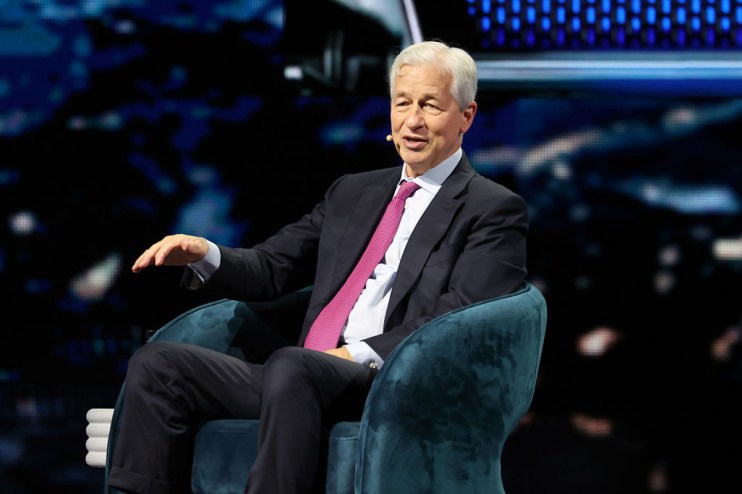
One of the biggest names in global banking issued a stark warning about global political uncertainty and the potential threat of higher asset prices on Monday, while pointing to the faltering pipeline for company flotations.
Jamie Dimon, the chief executive of JPMorgan Chase, added his voice to a debate raging in world financial centres on the impact and uncertainty stoked by war.
And he spoke of his surprise at the number of private companies seeking public listings for their shares, comments that will ring especially loudly in London, where a dearth of initial public offerings has been a hot topic.
The warning
There was an over-arching warning about the economic impact of higher inflation and rising interest rates, not least for a banking sector with uneven lending standards at industry level.
“Now, because of the war in Iran, we additionally face the potential for significant ongoing oil and commodity price shocks, along with the reshaping of global supply chains, which may lead to stickier inflation and ultimately higher interest rates than markets currently expect,” Dimon wrote.
“Continual trade negotiations exacerbate the tense geopolitical issues. And high asset prices, which certainly feel good in the short run, create additional risk if anything goes wrong.
Dimon is the best-paid banking chief executive in the US. He been at the helm of JPMorgan Chase for two decades, and steered it through the financial crisis of 2008, a feat for which he is perhaps best known, alongside leading it to status as the biggest bank by market value.
He had a stark warning about the dangers faced by the industry from factors that predate the wars in the Middle East and Ukraine:
“When we have a credit cycle, which will happen one day, losses on all leveraged lending in general will be higher than expected, relative to the environment.
“This is because credit standards have been modestly weakening pretty much across the board; i.e., more aggressive and positive assumptions about future performance (called add-backs), weaker covenants, more use of PIK (payment-in-kind; not paying interest in cash but accruing it), more aggressive private ratings (particularly in insurance companies) and more arbitrage (not always a great sign)”.
Dimon catching attention
Dimon’s annual letter to investors has become a set-piece event on Wall Street and in the City.
He caught global attention in an earnings call last year, when he also warned of rising credit risks. In a reference to a high-profile corporate bankruptcy, He said then “when you see one cockroach, there are usually more”.
This year, he returned to the theme, pointing out that “it has always been true that not everyone providing credit is necessarily good at it.
“There are many players who are late to this game, and it should be expected that some credit providers will do a far worse job than others. We have not had a credit recession in a long time, and it seems that some people assume it will never happen.”
He raised questions over the relative lack of initial public offerings at a time when markets have broken records..
“With stock markets at all-time highs in recent months, it is a little surprising that private equity firms, which own close to 13,000 companies, have not taken greater advantage of healthy markets to take their companies public,” Dimon added.
“Private equity investments are now held for an average of seven years — this is virtually double what it used to be.
“We have generally had nothing but a bull market since the great financial crisis — it’s hard to imagine what will happen if and when we have an extended bear market.”
#Jamie #Dimon #eyes #high #interest #rates #IPO #dearth #letter