
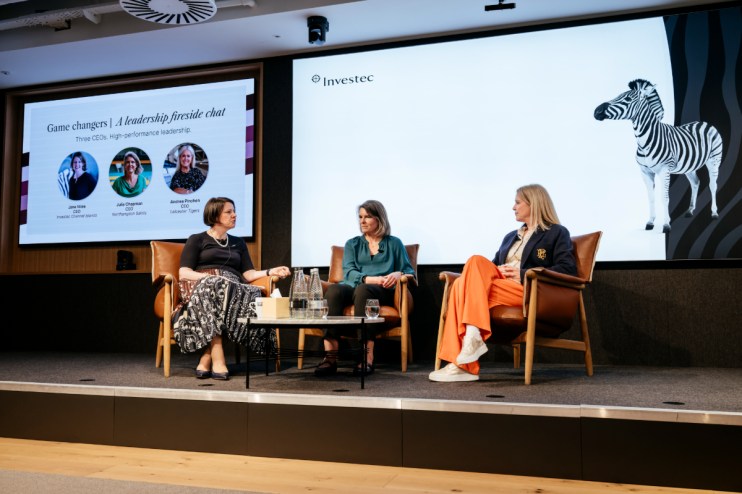
Senior female leaders have warned that progress at the helm of UK Plc is stalling, as they lay out the barriers women still face in leadership in male-dominated industries.
In a conversation with Investec Bank Channel Islands CEO Jane Niles, leading rugby union CEOs Julia Chapman and Andrea Pinchen reflected on their experiences running top-flight rugby clubs and what needs to change to get more women into top roles.
Pinchen said, “As leaders, we’re conditioned to not admit our mistakes and put on a professional front.”
“Very quickly, for me, I learned that leadership was about transparency and honesty.”
Chapman, on her part, said leading through Covid shaped her approach to risk and uncertainty: “Fear and uncertainty don’t have to prevent performance… recognise the fear, and push through it.”
“As leaders, we’re often conditioned to project certainty, to maintain a polished front that suggests we have all the answers. Very early on, however, I learned that effective leadership is rooted not in perfection, but in transparency and honesty,” Pinchen added.
The number of female chief executives in the UK remains low, with just seven women leading FTSE 100 companies.
Barriers still holding women back
Both bosses respectively said the biggest challenges are structural, particularly around career breaks and progression.
Chapman warned change is not happening fast enough: “At the stages in women’s careers where attrition spikes, change isn’t happening fast enough organically – policy regulation, and legislation need to step in and drive it.”
And, Pinchen added that businesses risk losing talent if they fail to support women returning to work.
“We invest so much in each individual”, she said, “why wouldn’t you welcome them back with open arms?”
Despite leading in a traditionally male sport, both said they had been accepted in their roles.
Pinchen admitted she initially hesitated about entering the changing room, saying: “I was mindful of not making anyone uncomfortable”, but that “the players have always been entirely respectful”.
Chapman added that access to the performance environment is essential. “You can’t fully understand a club unless you see it up close and are part of it”, she said.
Both leaders also stressed that stepping back and trusting others is key to running modern organisations, and also urged leaders to create environments where others can grow.
“It’s about encouraging collaboration”, Pinchen said, and Chapman added: “You must be able to say, ‘I don’t know how to do this’… If you lead with that willingness to be vulnerable, other people are more likely to follow”.
“I’ve made tons of mistakes, and I think that’s actually a positive thing. You should never feel like you can’t make mistakes,” Chapman noted.
“An example I learned quite early on was about communicating better with people, which I need to continuously work on, because I’m the sort of person who can become quite introverted when I’m under pressure. Don’t assume that because you’ve said something once means it’s been heard, understood, and acted upon. Check in often and reinforce the messaging,” she added.
Women in rugby leadership roles
While progress has been made at the board level, the number of women reaching the top job remains limited, raising fresh questions about whether UK businesses are doing enough to build the next generation of leaders.
Women now hold 43 per cent of board positions across the FTSE 350, maintaining the 40 per cent target first achieved in 2023. However, the number of female CEOs in the FTSE 100 has stalled, with only eight women in the top job at the end of 2025, the same number as in 2021. Meanwhile, the number of women leading UK mid-market businesses dropped from 24 per cent in 2025 to 17 per cent in 2026, the lowest level in eight years, according to the Chartered Governance Institute.
#Female #rugby #CEOs #breaking #barriers #maledominated #industries