
President Donald Trump struck an optimistic tone for prospects that the US and Iran could clinch a permanent ceasefire as the two sides discuss an extended truce ahead of its expiration next week.
“It’s looking very good that we’re going to make a deal with Iran, and it’s going to be a good deal,” Trump told reporters at the White House Thursday. Talks between Washington and Tehran could resume this weekend, he said.
Trump claimed, without evidence, that Iran had agreed to terms it has long resisted, including giving up ambitions for a nuclear weapon and turning over atomic materials. The deal would also include “free oil” and an opening of the Strait of Hormuz, Trump added. Tehran hasn’t publicly confirmed it’s made those concessions.
Read: Global stocks hit record on Iran bets, dollar ebbs: Markets wrap
While Trump expects a quick resolution, some Gulf Arab and European leaders believe a deal could take about six months, and that the ceasefire should be extended to cover that period, officials familiar with the matter said.
The US president didn’t expect he would have to extend the two-week ceasefire in order to reach a deal, predicting a resolution would be made “fairly soon,” but that if he needed to, he would.
Brent fell toward $98 a barrel after rising almost 5% on Thursday, while West Texas Intermediate was near $93. Real-world oil prices remain well above futures as near-term supplies are scarce. Dated Brent, the world’s most important gauge of physical prices, is trading around $116 a barrel.
ADVERTISEMENT
CONTINUE READING BELOW
Trump sought to ease voters’ concerns about the rising living costs and energy prices at a rally Thursday to build support for his economic record ahead of November’s midterm elections. Polls show a majority of Americans disapprove of the president’s handling of the conflict and blame him for rising gasoline prices.
Read: US, Iran weigh truce extension with Hormuz still shuttered
Trump said Israel and Lebanon had agreed to a 10-day ceasefire starting at 5 p.m. New York time, a move aimed at easing regional tensions. Israeli Prime Minister Benjamin Netanyahu confirmed the truce, calling it a step toward a broader peace agreement. Trump said US officials would work with both sides to secure a lasting deal.
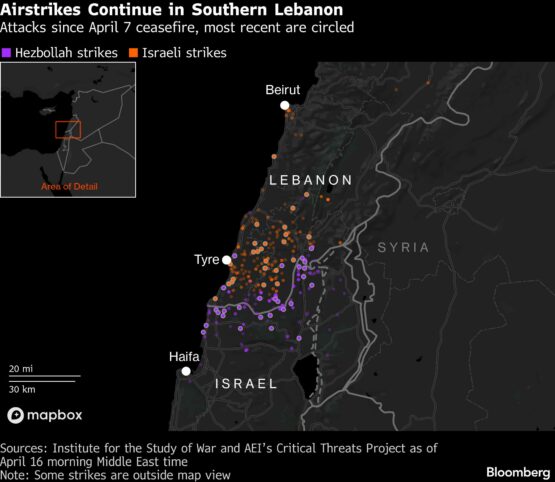
Israel has been hammering Iranian proxy Hezbollah in southern Lebanon, with the campaign threatening to derail the separate ceasefire with Iran. Trump’s announcement made no mention of Hezbollah.
Trump said he spoke with his Lebanese counterpart, Joseph Aoun, and Netanyahu before declaring the ceasefire. In a subsequent post, Trump said he would invite both leaders to the White House for talks. Later he said that visit could take place within a week.
Separately, Pakistan’s army chief, Asim Munir, traveled to Iran this week as his nation seeks to mediate a longer truce between Washington and Tehran. Pakistan hosted high-level talks between US and Iranian officials last weekend — discussions that failed to yield a breakthrough amid the six-week war. Munir was greeted by Iran’s Foreign Minister Abbas Araghchi.
Read: Trump Hormuz blockade risks showdown with China before Xi summit
Trump said Thursday that he “might” travel to Pakistan if a deal with Iran is clinched.
ADVERTISEMENT:
CONTINUE READING BELOW
“They’ve agreed to almost everything,” Trump said. “They got to get to the table with a pen.”
The US and Iran are considering a two-week ceasefire extension, according to a person familiar with the matter, who asked not to be identified discussing sensitive talks. Neither side wants to resume fighting, said another person familiar with the discussions.
Comments from both Iranian and US officials on Thursday suggest the sides remain far apart on key issues, but the ceasefire with Lebanon could provide fresh momentum. Iran’s Parliament Speaker Mohammad Bagher Ghalibaf, who took part in the Pakistan talks, had earlier said a permanent ceasefire must cover the fighting in Lebanon.
Some Gulf Arab and European leaders want an immediate reopening of the Strait of Hormuz and warn of a global food crisis if it remains closed beyond next month, said officials familiar with the matter, who asked not to be identified discussing private talks.
Control over Hormuz, a key waterway for energy supplies, remains contentious, with a US naval blockade now into its fourth day. Iran, which has effectively shuttered the strait since the start of the war, is meanwhile pressing ahead with plans to charge ships for transit even after the war is over.
Read: Lagarde says early ECB exit no option with clouds on horizon
The UK and France will host a summit with about 40 nations to discuss a multinational naval force to secure Hormuz, though deployment remains unlikely until a broader agreement is reached.
ADVERTISEMENT:
CONTINUE READING BELOW
Defense Secretary Pete Hegseth said US forces are ready to resume combat “at the push of a button,” while Iran warned a prolonged blockade could breach the ceasefire. The US is also preparing to deploy additional troops to the region, the Washington Post reported.
Fourteen vessels have turned back in three days rather than test the blockade, US Central Command said.
Israel has continued operations against Hezbollah despite pausing strikes on Iran, complicating peace efforts. The conflict has killed more than 2,000 people and displaced about a million, Lebanese authorities say, while talks between Israel and Lebanon began this week in Washington.
Read: Trump says end to Iran war in sight, spurring market rally
Disputes over Iran’s nuclear program remain central to the conflict. Tehran insists it isn’t pursuing weapons and says its right to peaceful nuclear energy can’t be revoked, though enrichment levels remain negotiable, officials said.
© 2026 Bloomberg
#Trump #sees #good #prospects #permanent #USIran #ceasefire #deal