
A torrid rally in shares of Avis Budget Group has suddenly reversed, causing the price to plummet 48% and triggering multiple trading halts on Thursday.
The decline deepened a selloff that’s wiped out nearly 70% of the car-rental company’s value in the past two days, marking an abrupt end to an advance that began late last month.
The company had been heavily targeted by short sellers who had sold borrowed stock, wagering it would decline. But after Pentwater Capital Management LP in March disclosed that it had acquired a sizable stake in the company, some investors raced to buy back the shares to close out those positions, which sent the price surging more than 600% in a little over four weeks.
That jump — and the abrupt reversal — echoes the moves seen during the meme-stock frenzy of the pandemic, when day traders banded together to push up stocks of companies like GameStop that were targeted by short sellers.
“When a short squeeze like Avis this month or GameStop in 2021 occurs, it attracts retail attention and creates a herd mentality,” said Michael O’Rourke, the chief market strategist at JonesTrading.
ADVERTISEMENT
CONTINUE READING BELOW
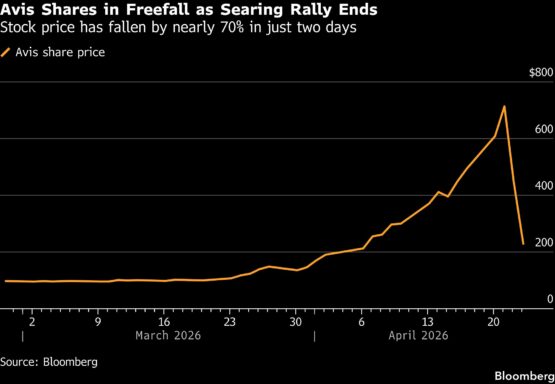
The steep run-up in Avis’s stock had drawn considerable attention on Wall Street, where some analysts were warning that it was almost certain to snap eventually, given that it seemed to have little connection to the company’s underlying fundamentals. It also ripped through to shares of rival car rental firm, Hertz Global Holdings Inc., which had nearly doubled since late March, only to tumble over the past three days.
Wall Street analysts were already bearish when investors were piling into bets against the company. At the end of March, the majority of those who tracked the company were advising investors to either hold on to it or sell.
The market dynamic shifted after Pentwater’s share purchases set off a rush to close out those bets, given that a large chunk of the stock had been snapped up. The firm owns about 20% of Avis’s shares, with SRS Investment Management holding over 49%, according to data compiled by Bloomberg.
The company on March 27 filed for a so-called “at-the-market” offering for up to 5 million shares, a process that allows companies to sell shares into the open market at prevailing prices. That would have given it an opportunity to seize on the share-price jump, though the company has not disclosed issuing any stock under the program. Avis didn’t respond to requests for comment.
ADVERTISEMENT:
CONTINUE READING BELOW
The share price surge hit short sellers hard and made Wall Street analysts even more negative on Avis’s stock. On Thursday, JPMorgan Chase & Co. analyst Ryan Brinkman cut the stock to underweight, the equivalent of a sell, saying it had “risen far above the level we feel can be justified by even the most optimistic view of underlying earnings fundamentals.”
“It was 100% driven by the float and by momentum, algorithms and the short squeeze,” said Bruce Cox, president and portfolio manager at Harrington Alpha Fund, who was among those who shorted Avis.
“It’s like a domino,” he said. “There was no reason, fundamentally, for the rise in the stock.”
The drop may be providing some relief to investors who bet against Avis. Those “who could stomach the recent enormous mark-to-market losses are seeing a light at the end of the tunnel,” said Ihor Dusaniwsky, a managing director at S3 Partners.
© 2026 Bloomberg
#Avis #sinks #days #setting #cascade #trading #halts