
Saudi Arabia has achieved a huge boost in crude exports through its Red Sea terminals, but has yet to stabilise flows at its target level for the route.
Shipments of crude to overseas destinations from Yanbu have averaged about 4 million barrels a day in the first three weeks of April, data compiled by Bloomberg show. That’s about five times as much as Saudi Arabia exported on the route before the conflict in Iran started, but still only about 80% of Riyadh’s target.
Oil markets are closely watching flows of oil from the terminals on Saudi Arabia’s west coast after Iran all but blocked the Strait of Hormuz following attacks by the US and Israel at the end of February. Yanbu represents the industry’s single-biggest workaround for the blockage of the waterway.
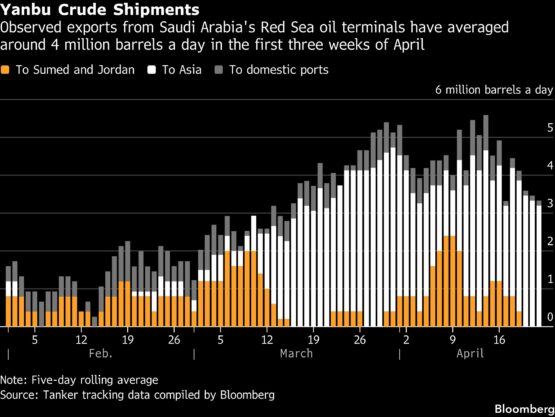
It’s possible that some tankers could have turned off their digital transponders, which would have resulted in a low count and an underestimation of exports. Bloomberg also uses standard cargo sizes whereas vessels calling at Yanbu could have been filled to the brim.
ADVERTISEMENT
CONTINUE READING BELOW
Saudi Arabia’s energy ministry didn’t respond to a request for comment.
The East-West conduit can carry 7 million barrels a day from oil fields close to the kingdom’s Persian Gulf coast to Yanbu on the Red Sea, a distance of 746 miles. About 2 million barrels a day of that is earmarked for domestic usage.
Pumping reached its full capacity of 7 million barrels a day in late March and exports hit 5 million a day, a person familiar with the matter said at the time.
But shipping data suggest that was only sustained for a few days, and export flows over a longer duration have run at lower levels.
ADVERTISEMENT:
CONTINUE READING BELOW
Shipments were hampered in part by a drone strike on one of 11 pumping stations along the line’s route. That briefly reduced capacity by about 700 000 barrels a day, but was quickly repaired.
Yanbu was used by Saudi Arabia for cargo shipments to storage tanks in Egypt, from where cargoes get delivered to refiners in Europe and along the east coast of North America. Now, the vast majority of shipments are being directed to Asia.
A large flotilla of empty tankers built up off Yanbu in the first days after Hormuz was closed, rising to at least 40 ships as they waited for diverted barrels to arrive at the port.
As of Tuesday, there were still more than 20 very large crude carriers anchored empty in the area, most belonging to the kingdom’s own shipping company, the tracking data show. There are still plenty of tankers available to support Saudi Arabia’s elevated volume of Red Sea shipments.
© 2026 Bloomberg
#Saudi #Arabias #Hormuz #oil #bypass #maintain #full #exports