
African startups are rewriting their funding playbook as the global artificial intelligence boom pulls venture capital toward the US, forcing emerging markets to compete for cash.
AI-related VC investment doubled to $259 billion last year from 2023, with three-quarters of it flowing to US companies. That’s prompting founders from across Africa to turn to domestic sources such as development-finance institutions, pension funds, debt providers and local VCs.
The shift accelerates a reset for a startup ecosystem long dependent on overseas growth capital. Investors are now demanding clearer paths to profitability and greater resilience to shocks ranging from war-driven inflation to higher borrowing costs, according to Abakar Mahamat, founder of Telemedan, a healthcare startup in Chad.
“Earlier, many investors were excited by ‘Africa growth stories’ and expansion potential alone,” he said. “Today, most want to see operational discipline, unit economics, partnerships, and a path toward sustainability. A lot of conversations shifted from ‘How fast can this scale?’ to ‘How resilient is the model?’”
Geopolitics combined with the lure of AI will likely spur overseas investors to be more selective on the continent, according to the African Private Capital Association, or AVCA.
ADVERTISEMENT
CONTINUE READING BELOW
“In the US you obviously have a lot of homegrown AI that maybe isn’t happening to the same extent in Africa,” Andrew Firman, the Dallas-based managing partner of Kaleo Ventures said on Bloomberg’s Next Africa show. “Naturally, I would expect the numbers to show increases in African investors. US investors are just capturing a domestic opportunity.”
A Bloomberg survey published Thursday of 25 startups to watch on the continent found that local funders accounted for 47% of commitments while less than a quarter were from the US. Between 2022 and 2024, funding from African investors averaged 23%, according to the AVCA.
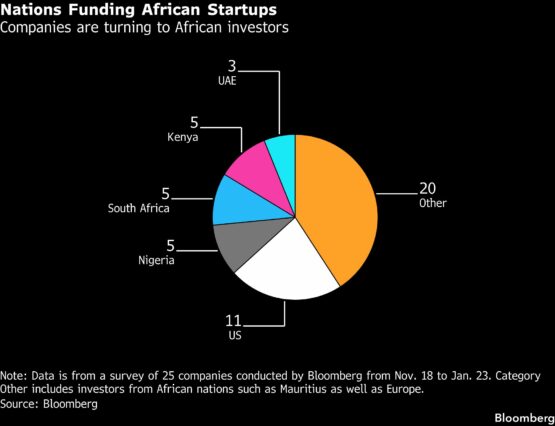
The rising cost of capital “is making domestic investors say, ‘well, actually, maybe I should be investing more of my money closer to home and less into these volatile geopolitical environments,” said Tokunboh Ishmael at Lagos-based Alitheia Capital.
New companies on the continent raised $2.1 billion in equity funding last year, according to AVCA, down 21% from a year earlier. They also raised $1.8 billion in debt – a 91% increase from 2024.
The second edition of the startup survey also found that South Africa, Nigeria and Kenya each accounted for 16% of the 25 companies identified as ones to watch.
ADVERTISEMENT:
CONTINUE READING BELOW
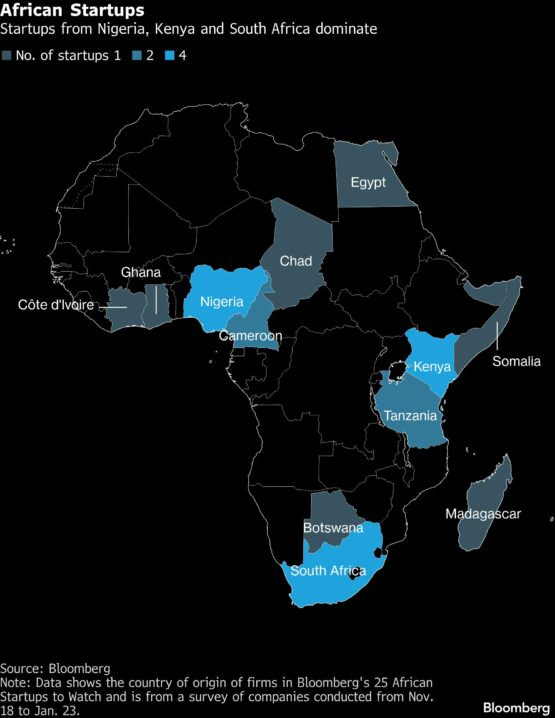
The shift to find local backers may spur innovation in frontier markets, beyond Africa’s major economies.
Angola is emerging as one of the continent’s fastest-growing technology hubs. Its startup ecosystem grew 70.8% over the past year, according to rankings by StartupBlink, reflecting rising startup activity, investor interest and international visibility. Uganda’s sector expanded 32.5%, while Algeria recorded growth of 38.7%.
“Preferences continue to centre on Africa’s ‘Big 4’ economies,” AVCA said in a separate report, referring to South Africa, Nigeria, Kenya and Egypt. “Interest in frontier markets such as Uganda and Senegal signals a measured broadening of investment opportunities.”
© 2026 Bloomberg
#Africa #startups #turn #boom #drains #venture #capital