
As November gets underway, it is fair to say that it has been a very eventful year. While 2025 was a terrific year for South African investors, 2026 has been tough going, particularly for the local equity market.
From an investor’s perspective, it has been a particularly ‘ODD’ year, dominated by oil, data centres and debt.
Let’s take a closer look at each.
Operation Epic Folly
When the US and Israel attacked Iran in late February, US President Donald Trump was probably hoping for a repeat of the raid on Venezuela, which quickly toppled its strongman leader, Nicolás Maduro.
However, not only is Iran’s regime still standing, but it also spread the fighting throughout the Gulf region.
Most notably, it attacked shipping in the Strait of Hormuz, disrupting the world’s most important maritime channel for seaborne oil.
Read:
The US midterms: Three outcomes that could reshape markets
Iran’s main oil terminals remain empty as US blockade bites
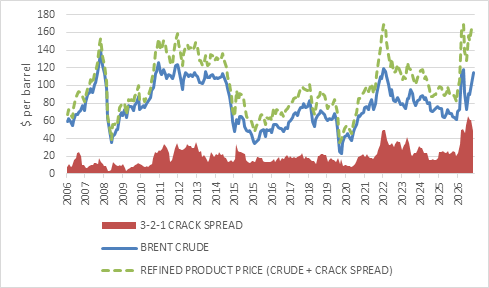
What followed was a predictable spike in the price of crude oil. It jumped from $60 per barrel at the start of the year to $120 per barrel in April, before peace talks and an eventual ceasefire calmed things down by mid-year.
The second phase of the 2026 oil shock started around September, when it became clear that the ceasefire would not be durable. Fighting between the Iran-backed Houthi rebels from Yemen and Saudi Arabia have sparked further fears of sustained supply disruptions.
Read:
Deadly attacks on Saudi Arabia risk wider war that draws in US
Trump says he does not believe Russia and China are helping Iran
Despite this, it appears that oil exports from the region have nearly recovered to pre-war levels.
The fact that the crude oil price has headed back towards $120 therefore reflects a substantial risk premium, as well as a dramatic increase in the cost of shipping. Ship captains, owners and insurers naturally want compensation for navigating the gauntlet through Hormuz.
Barrel half full
Whether the glass (or barrel) is half full or half empty depends on what one chooses to focus on.
On the one hand, crude oil prices never reached levels that would be considered extreme by historical standards, as the solid line in the chart below shows.
Crude oil and refined product prices
Source: LSEG Datastream
However, refined product prices have increased much faster than crude prices over the past two months or so. The solid area on the chart above shows the ‘crack spread’, a proxy for refinery margins.
Apart from refineries in the Middle East, plants in Russia have also been damaged in the ongoing war with Ukraine.
Add the crack spread to the crude oil price, and the dotted line approximates the price that consumers and firms pay for fuel. This is near record levels.
ADVERTISEMENT
CONTINUE READING BELOW
Nonetheless, the world economy has been resilient.
This is partly because we are less dependent on fuel to generate economic activity compared to 20 or 30 years ago. For instance, modern petrol cars are far more fuel-efficient, and the share of electric and hybrid vehicles has grown.
Moreover, the fuel price spike has not been compounded by an interest rate shock and surging US dollar as in 2022.
Finally, there is the data centre boom.
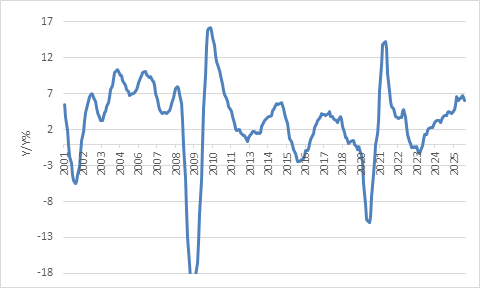
Global export volume growth
Source: CPB World Trade Monitor
The massive build-out of data centres powering artificial intelligence (AI) models has been compared with some of the largest capex booms in history.
Although much of the construction is taking place in the US, the components are sourced from across the world.
These include semiconductors from Taiwan, memory chips from South Korea, electronics from China, server systems from Germany, grid equipment from Japan and copper from Chile, among many others.
As a result, global export volumes have continued to grow strongly over the past year, despite US tariffs.
There is no question that data centre construction is boosting the world economy, and the US in particular, at an otherwise difficult time.
The question is whether all this spending will generate a sufficient return or end up creating massive white elephants.
Few doubt that AI will be a transformative technology, but it ultimately depends on how much people and companies will be willing to spend on it, and whether the AI companies will have pricing power.
For instance, Gartner, the tech consultancy, calculated that spending on AI by customers would need to be a cumulative $8.5 trillion by 2030 for data centre owners to cover capex, financing costs and earn a decent return.
Read:
AI race puts $3.5trn at write-down risk, Gartner warns
Tencent kicks off $5bn bond sale to finance AI spending
AI faces $6trn test to justify data centres, Bain says
However, it believes this number will only be $3.5 trillion – still a massive amount, but not enough. This is just an estimate, but it does suggest that many firms without strong competitive business models and sticky customer relationships will struggle to survive.
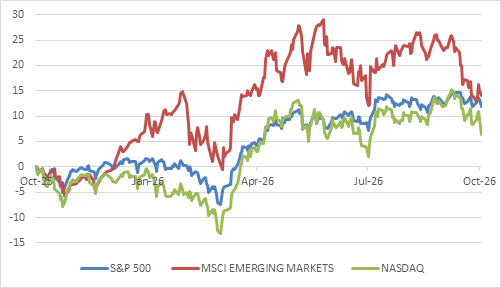
Investors have grappled with these issues since the AI rally started, and mostly decided things will be fine.
However, there have been periodic pullbacks in the market, including the past two weeks.
Equity indices in dollars
Source: LSEG Datastream
These corrections are uncomfortable, but necessary.
It is much better for investors to recalibrate expectations regularly along the way than to wake up one morning realising that their projections were way off.
This is especially true since data centre construction is increasingly funded with borrowing from banks, private credit funds, the bond market – or from suppliers (also known as circular funding).
A different form of liability that is funding the data centre boom is ‘take-or-pay’ agreements, where AI labs have committed to pay for data centre capacity even if they don’t ultimately use it.
ADVERTISEMENT:
CONTINUE READING BELOW
This has understandably raised eyebrows.
The longer a borrowing binge carries on uninterrupted, the worse the fallout when investors eventually realise they’ve overdone things.
There have been plenty of such capex cycles in real estate and other sectors to demonstrate this point.
Moreover, the more the debt is structured in complex, opaque and off-balance sheet vehicles, the greater the odds of a serious reckoning.
Debt
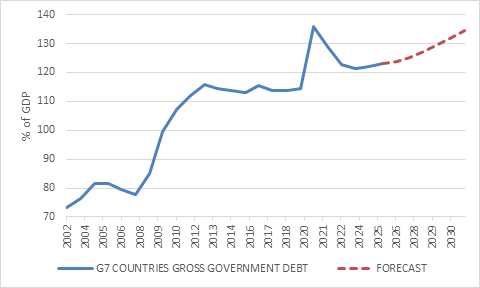
Data centres and debt therefore intersect, but the worrying rise in global government debt levels long predates the AI frenzy.
According to the International Monetary Fund (IMF), the global government debt-to-GDP ratio is on course to reach levels last seen in the wake of World War II, led by the advanced economies. (The 2020 spike in the seen in the chart below was because the denominator fell so sharply during the Covid-19 pandemic).
G7 countries gross government debt
Source: International Monetary Fund
Data centre builders borrow much less than governments, but they are still competing for the same pool of available savings and investment capital.
By supporting economic growth this year, the datacentre boom also indirectly contributed to interest rate increases.
Central banks usually look through oil price spikes, but when the underlying economy is healthy, they fear second-round effects where businesses pass on cost increases to consumers.
Read: Global cash is funding US AI boom despite fears of hidden debt
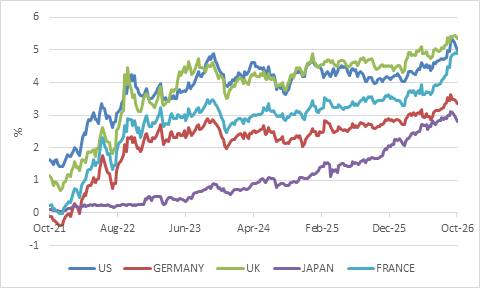
Major central banks have hiked rates this year, while we’ve also seen substantial increases in government borrowing costs (bond yields).
This compounds the debt problem.
New borrowing and rolling of maturing debt now take place at higher yields. raising the long-term interest burden. This reduces the borrower’s creditworthiness, potentially putting further upward pressure on yields.
10-year government bond yields, %
Source: LSEG Datastream
A full-blown debt crisis in the markets is not inevitable, particularly where governments borrow in their own currencies. They can find ways of keeping the funding taps open, including ‘financial repression’ that artificially lower the interest burden.
However, while a government can force domestic institutions to lend it money, it cannot force foreigners. Currency weakness might still provide the escape valve, and the US dollar’s special status does not make it immune to this risk.
Finally, as we’ve seen with riots in France recently, the fiscal crisis doesn’t necessarily appear in the markets, it can also show up in the streets.
Looking ahead
ADVERTISEMENT:
CONTINUE READING BELOW
Whether 2027 will also be ODD depends greatly on politics. While AI is a commercial enterprise, the potential risks mean that increased regulation is almost inevitable.
The current US administration is very AI-friendly, especially as it views the AI race with China as critical for national security. However, that will not necessarily be the case in future.
In contrast to previous exciting new technological developments, people fear the impact of AI on jobs, cybersecurity, and social stability.
Communities across the US are also pushing back against data centre construction in their backyards.
This will feature in this week’s elections, where Americans will vote not only for their Congressional representatives, but also for thousands of state and local level officials who could put the brakes on some data centre construction.
Read: The bond market is putting a price on political promises
The outlook for the oil price also depends on politics and geopolitics.
There is talk of another major US and Israeli strike on Iran after the midterm elections, but it is hard to see what further bombing can achieve that previous strikes could not.
The squeeze on Iran’s economy through sanctions and blockades could be more effective in forcing Iran to make concessions, but it will take time.
For now, we remain stuck with elevated oil prices, but they can come down very quickly if there is a durable peace process.
It is also worth remembering that the world is not short of oil, it is just trapped in the wrong areas.
Reconfiguring flows of the right grades of crude to the right places will take time but will happen eventually. Previous big run-ups in the oil price were always followed by significant declines, as the first chart in this article shows.
In the meantime, however, it will squeeze the global economy. Although it adds to inflation, central banks need to be cautious because eventually the downward pressure on real incomes exceeds the upward pressure on inflation.
Finally, while some of the upward pressure on government bond yields this year is probably temporary, high levels of government debt are structural.
Developed countries have ageing populations, while internal polarisation means the political will to deal with the issue decisively is missing.
France is the dramatic case, while last week’s UK Budget was a more insipid example. Perhaps only a real crisis will force meaningful fiscal discipline.
Therefore, while global bond yields are looking much more attractive compared to recent years, investors will still need to navigate longer-term worries.
As it happens, South Africa is a rare example of a government trying to reduce its borrowing.
The rebased and recalculated GDP numbers from Stats SA improve the debt-to-GDP ratio optically (nominal GDP is 5% larger than previously estimated), but the rand amount of outstanding government debt remains at R6 trillion, and the portion of tax revenues needed to service this debt remains at 20%.
Read/listen:
SA economy 5.3% bigger than thought after GDP rebasing
Fitch vs Treasury: Is SA’s debt outlook improving?
Therefore, it seems likely to still be an ODD world, though no doubt 2027 will bring other themes and trends to worry about.
The flipside of challenging times in markets is usually that new opportunities emerge, but it remains a time for being appropriately diversified and not making big bets.
Izak Odendaal is an investment strategist at Old Mutual Wealth.
#Investing #ODD #world