
Oman, a Middle Eastern sultanate that rarely draws much attention, is scoring billions of dollars in economic growth and emerging as a big regional winner from the Iran war.
As conflict continues to roil the region, a combination of geography, diplomacy and economic policy have spared Oman the worst of the war and allowed it to play a more central role in the region.
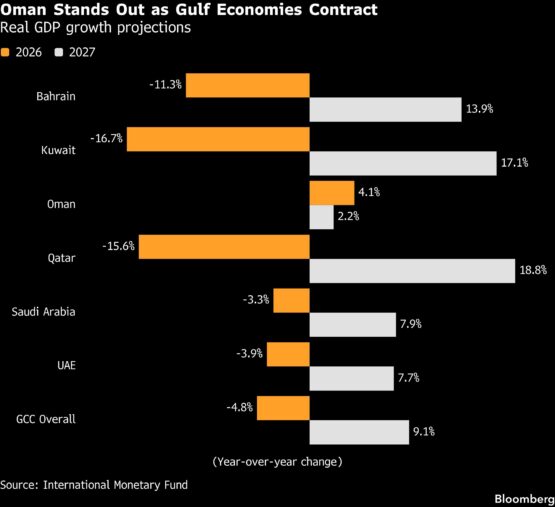
The International Monetary Fund projects that Oman’s economy will grow 4.1% this year, adjusted for inflation, even as the other economies in the six-member Gulf Cooperation Council contract.
Now, the nation of 5.4 million – which has largely escaped Iranian attacks that have upended much of the region – is seeking to convert its gains into a long-term windfall.
Read:
Oil extends declines as Iran, Oman push talks to reopen Hormuz
Trump threatens to bomb Oman if it gets in way of US, Fox says
Muscat is courting investors for its ports, planning an international financial centre and chasing the artificial intelligence boom. Meanwhile, luxury resorts and beach clubs are still springing up along its coastline.
In recent months, Oman has held talks with Iran on the management of Hormuz. At the same time, Chinese President Xi Jinping has hosted Oman’s Sultan Haitham bin Tariq in Beijing in recent days, highlighting the Gulf country’s growing global geopolitical importance.
Meanwhile, its geographical location has given it key ports that stand outside Hormuz and open into the Gulf of Oman and the Arabian Sea.
All that’s ensured that its benchmark index has jumped about 24% this year even as major indexes in the United Arab Emirates and Saudi Arabia have declined.
Oman offers some, but by no means perfect, margin of safety that will make heavy industry investment a bit more attractive, according to Steffen Hertog, a professor at the London School of Economics and Political Science. But there are limits to the country becoming a logistics hub after the war, he cautioned.
“Oman’s Southern ports are far from Iran and Hormuz so could work as stops along longer routes between Asia, Africa and Europe,” Hertog said. “But they are not connected to the rest of the GCC and will struggle to become global hubs given the scale this would require.”
ADVERTISEMENT
CONTINUE READING BELOW
The country hasn’t been immune to Iran’s attacks, and fuel tanks at the Port of Salalah were struck by drones in March.
Meanwhile, its efforts to negotiate with Iran on how Hormuz should be managed have drawn the ire of US President Donald Trump, who earlier this year asserted that “Oman will behave just like everybody else,” threatening that otherwise “we’ll have to blow them up”.
Read:
Oil loading logjam at key Oman port puts flows under strain
Trump and Iran strike defiant tone as oil markets see little relief
Uncertainty over Iran and US military action
Plenty of uncertainties remain in the Middle East. Trump has repeatedly said he would resolve the Iran conflict one way or the other, occasionally threatening to resume strikes after the midterms.
In recent days, he’s said the US remained open to talks and suggested there had been progress, without offering any details or evidence.
Unlike in the rest of the Gulf Arab states, the US doesn’t have troops or bases permanently in Oman, although the two countries do cooperate militarily. Under defense agreements going back decades, American forces can access Omani facilities for some operations.
During the conflict, several Saudi accounts on X have voiced frustrations with Oman’s role in the region, underscoring the tight rope Omani officials are navigating in the region.
Read:
Oil steadies after tumbling 8% on optimism over US-Iran talks
Gold edges lower as traders weigh Fed-speak and US-Iran talks
Oil faces longest losing run in year on pipeline hopes, US talks
Even so, Oman’s relative insulation could bolster its ambitions beyond logistics. Muscat recently unveiled plans for an international financial centre, joining other Gulf capitals in seeking to lure Wall Street firms. Details are still scarce, but Oman aims to begin registering companies later this year, ahead of full operations in 2027.
“Oman’s economy is likely to outperform its GCC peers in the short term while the Iran conflict remains unresolved, the flow of shipping through the Strait of Hormuz remains impaired and the risk of further escalation persists,” said Farouk Soussa, Goldman Sachs Group Inc’s economist for the Middle East and North Africa.
Still, the country’s non-oil economy will take time to develop and its comparative advantage may not persist after the war, he said.
Sheikh Humaid Al Maani, head of the Diplomatic Academy at the Ministry of Foreign Affairs, said the Omani ports of Duqm, Sohar and Salalah are bolstering the country’s position.
Oman’s ports and its efforts to collaborate on trade with the global maritime industry add value to not just the country’s economy, but also to the “region and the world”, he said, highlighting the Muscat Maritime Resilience Forum that brought together regional and international companies in October.
ADVERTISEMENT:
CONTINUE READING BELOW
The maritime conference, organized by Oman’s Asyad Group with the country’s transport and foreign ministries, is part of a broader effort to expand the country’s role in trade and security.
The push builds on a dramatic economic turnaround. Just a few years ago, Oman’s ratings were placed in junk territory by all three major rating companies and concerns mounted that it could require financial support from wealthier neighbours.
Fiscal reforms, higher oil prices and privatisations have since helped Oman cut debt and restore its investment-grade ratings.
Read:
Saudis offer to sell oil near Oman
Iran says deal with Oman on Strait of Hormuz agreed in principle
Oil holds declines as Iran and Oman reach agreement over Hormuz
The government raised a record $2 billion from the 2024 listing of OQ Exploration & Production and is now discussing stake sales in key terminals with international companies and Gulf investors, according to Transport Minister Saeed bin Hamoud Al Maawali.
In June, France’s CMA CGM and Asyad also signed a $400 million agreement to develop and operate a logistics terminal at Sohar Port.
“For this shock in particular, geography, existing infrastructure in ports that are outside allowed Oman to be less affected, but also to benefit from this access,” said Jihad Azour, the IMF’s Middle East director, said about the impact of the Iran war.
He also pointed to reforms that reduced indebtedness and strengthened macroeconomic stability.
Another challenge would be income tax. Last year, the nation announced plans to impose the levy, becoming the first Gulf state to do so in an effort to broaden its sources of public revenue beyond oil.
Tax-free income in the likes of Saudi Arabia, the UAE and Qatar has been a big draw for foreign workers, making Oman’s move risky in terms of talent attraction.
Oman still trails regional peers in global finance. Its $60 billion sovereign wealth fund is a less prolific dealmaker than those of its neighbours, though privatisations helped propel Oman past London in initial public offering volumes in 2024.
Its stock exchange is also on FTSE Russell’s watch list for a potential upgrade to emerging-market status, while state-backed OQ Exploration & Production has appointed a panel of banks to explore international acquisitions primarily in the Middle East, East Africa and North Africa, a company spokesperson said.
ADVERTISEMENT:
CONTINUE READING BELOW
Oman eyes opportunity in the Gulf’s AI race
Oman may also find an edge in the Gulf’s race for AI and data centres. The war has exposed the vulnerability of facilities elsewhere in the region, potentially making the sultanate a more attractive alternative.
Muscat is set to sign an agreement with the UK’s Yamna for a large-scale AI data centre in Salalah, with the first phase expected to cost more than £1 billion ($1.3 billion). Oman still significantly trails its neighbours Saudi Arabia and the UAE in terms of data centre capacity and deals with international AI companies.
Read: Wall Street is searching for AI winners across emerging markets
Its tourism industry has also sought to differentiate itself. Leaning on its natural beauty, from mountains and ravines to its coastline and varied climates, the country has largely shied away from the glitzy beach clubs that have helped make Dubai a major tourist draw.
Still, there are signs that Muscat is looking to attract some of the same travelers. High-end beach club Nikki Beach is set to open in Muscat next year.
South of the capital, the Trump Organisation is building a gated community overlooking the Gulf of Oman as part of a development that will include the Trump International Golf Club.
Omani officials say that some of the economic benefits they are seeing during the conflict are going to stick.
Read: Trump tells Iran he wants a deal on Hormuz agreed imminently
Some firms doing business in the Gulf have already decided to have export capacity, especially to India and Africa, based in Oman, Al Maawali said. “So that will bring some long term benefit,” he said.
© 2026 Bloomberg
#Oman #seeks #turn #wartime #windfall #lasting #economic #gains