
For months, investors have been worrying about a long list of risks to the gravy train of artificial intelligence spending.
This week, they hit the panic button.
Fears of the worst-case scenario for the AI trade kicked in after the US midterm elections on Tuesday, in which Democrats secured majorities in the Senate and House of Representatives and won control of state houses and governor’s mansions across the country. Many of the winning candidates ran on anti-AI platforms, raising the possibility that the development of data centres could grind to a halt in many places.
That realisation sent traders racing for the exits starting on Thursday, dumping shares of everything tied to the hundreds of billions of dollars in projected AI spending. The Philadelphia Stock Exchange Semiconductor Index plunged 12% while the tech-heavy Nasdaq 100 Index fell 6.4%, the biggest one-day drops for both since the Covid pandemic hit in March 2020. And AI poster child Nvidia Corp. led the market lower, tumbling more than 9% and losing more than $440 billion in market value.
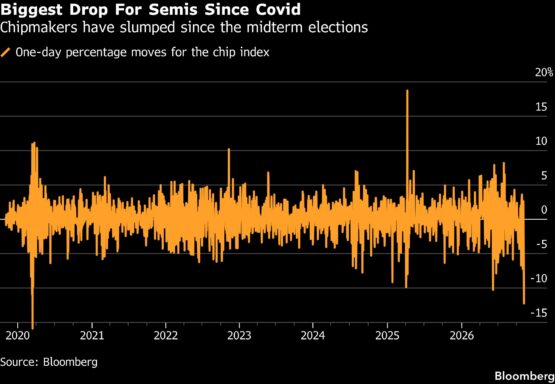
“People are questioning the growth assumptions for data centre suppliers and pulling back pretty broadly,” said Peter Tuz, president of Chase Investment Counsel, whose fund owns shares in chipmakers Nvidia and Advanced Micro Devices Inc. as well as major AI spenders like Alphabet Inc. and Amazon.com Inc. “It is easy to draw a line from the election results to increased uncertainty toward the regulatory environment, and from there to the growth outlook for these companies.”
Anxieties about AI spending had been mounting for much of the year amid rising interest rates, higher levels of debt being raised to fund the build-out and an increasingly vocal backlash against data centre development. That spending has been key to the rise in the S&P 500 Index and has insulated the benchmark from macroeconomic problems, including high oil prices, elevated inflation and risks from the war in Iran.
ADVERTISEMENT
CONTINUE READING BELOW
It remains to be seen how efforts to rein in data centre development and regulate AI will play out, of course, considering how slowly the gears of government often move. But the selloff shows the level of fear that the heart of the bull market is in trouble.
“It feels like the economy is firing on one cylinder, and that cylinder is not only not pumping as fast as it used to, but it may even slow further due to the election,” said Barry Knapp, managing partner at Ironsides Macroeconomics. “I’m not a buyer of anything right here.”
Nearly one-third of computing power projected to come online in the US in 2028 is now at risk, according to estimates by strategists at UBS Group AG. A majority of that is from data centres planned in Texas, where Gina Hinojosa, who has vowed to halt new data centre approvals, defeated Republican Greg Abbott to become the first Democrat to win a governor’s race in the state since 1990.
Those concerns are prompting a rethink of the AI trade’s valuations, which were already under pressure. Take Nvidia, which has been the biggest beneficiary of AI investment. It’s trading at 13 times profits estimated over the next 12 months, down from more than 32 times a year ago. Broadcom Inc., the second-most valuable US chipmaker, is priced at 15 times estimated earnings, down from a peak of 42 times in December.
“People were acting like data centres were a new state of affairs that could be projected out years into the future,” Knapp said. “If we only build data centres for a couple more years, then chips go back to a slower pace of growth over time, what price should you pay for that?”
The selloff has been particularly brutal in the riskiest corners of the AI trade. CoreWeave, the provider of AI-computing services, has tumbled 20% this week, leaving it down more than 75% from a June 2025 peak and just a few dollars from its March 2025 initial public offering price. And debt-laden neocloud provider Nebius Group NV lost 15% on Thursday, bringing its decline from a June high to 58%.
ADVERTISEMENT:
CONTINUE READING BELOW
To make things even more challenging, uncertainty surrounding regulation and oversight of AI and the data centre build-out has left investors wary of stepping in to buy the dip.
“It is difficult to say that this has gotten excessive, since we don’t know what the regulatory outlook is going to look like,” Chase Investment Counsel’s Luz said. “It seems like the move has gotten overdone, but we would not be buyers until the situation clears up some.”
One upside to a slowdown in data centre development is tech giants like Amazon, Alphabet, Microsoft Corp. and Meta Platforms Inc. would be forced to curb their spending. Selloffs in those stocks following the companies’ recent earnings reports showed how intolerant investors are of capital spending that’s outstripping cash generated from operations.
Those four companies, along with Apple Inc., saw their shares soar on Wednesday, adding more than $800 billion in combined market value, before giving up some of the gains on Thursday amid the broad selloff.
“If they cut back on spending, maybe they don’t have to borrow as much, maybe cash flow rises,” Luz said. “But at the same time, maybe growth slows. There are so many questions right now.”
© 2026 Bloomberg
#Wall #Street #peers #abyss #trade #midterms #expose #risk