
| Updated:
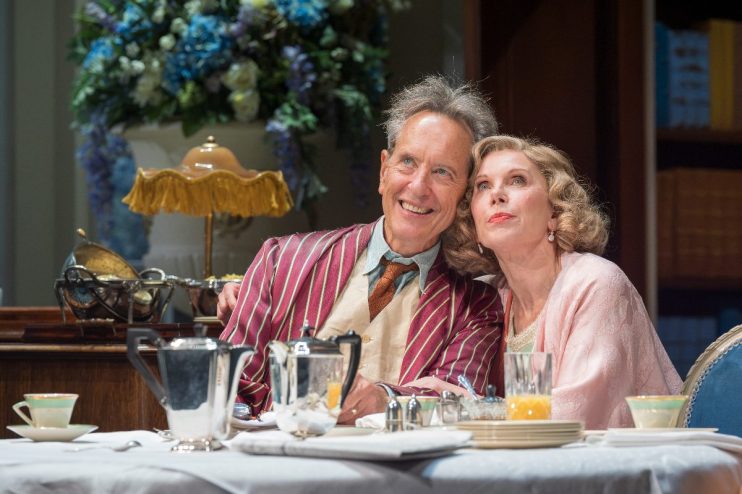
Of course, darling: Richard E Grant simply must play David Bliss, the blinkered, posho patriarch at the centre of Noel Coward’s drawing room comedy, Hay Fever. This is how I imagine the casting conversations went, anyway. Shockingly, E Grant – everyone’s favourite aristo-portrayer – has until now never starred in a Coward play, so here is his moment. He is delicious as the delusional novelist in Emily Burns’ Hay Fever, the latest proof that Coward is still more than capable of summing up our 21st century idiosyncrasies fifty odd years after his death.
You think these people are too flatly ridiculous to exist, and then you remember you know countless people like them. We’re in the Bliss household in the village of Cookham, Berkshire, where retired actress Judith Bliss is wafting around declaring that she is to make a return to the stage, although you suspect she says the same thing every day. Christine Baranski brings both heft and hilarity to the ludicrously delusional matriarch; her barbs drop heavily, but always dressed to the nines, she has a weightlessness, too (Judith is a fusing of two actual women Coward knew, one a New York socialite and one from London; the former loved the portrayal but the latter was deeply offended).
Richard E Grant in Hay Fever
Much like going for dinner at a family house, Hay Fever starts off fairly pedestrian. The gags don’t quite land, and no one has much of substance to say. By the interval you think Coward is outdated. But the playwright rewards the patient: just like on a real weekend in the country, the explosive revelations take their sweet time to come to the boil.
Essentially nothing much is going on, except that all four of the Bliss family, including son Simon and daughter Sorel, have invited guests to stay for the weekend. The incoming troupe, including Nancy Carroll’s London society type Myra and Ash Hunter’s amateur boxer Sandy Tyrell, are confronted by the family’s constant squabbling and petulant behaviour until they’re driven up the wall, and unite to draw up a drastic escape plan.
Coward’s central depiction of an exasperated couple still stings with contemporaneity. Judith and David do terrible things to one another but always fall resolutely back together. Coward’s best lines derive from Judith and David’s explosive tiffs. As Myra states of the couple, “you’re artificial to the point of lunacy.”
He’s magnetic to watch self-destruct
Richard E Grant is obviously perfect for the feverishly privileged, short tempered David, who, like so many poshos, is magnetic to watch self-destruct. I could watch the actor play angry, bellowing, gesticulating toffs for literal years, even if Saltburn, Withnail & I and the countless other roles have tended to typecast him. Baranski grips equally, flipping in milliseconds between sensual and ballistic, drawing on her Mamma Mia film performance to produce a flawless English accent (Maggie Smith premiered the part at the Old Vic in 1964, when the play become the National Theatre’s first production of a play by a living author).
Subtle and ferocious, Coward remains our best chronicler of the family bust-up.
Hay Fever plays at the Wyndham’s Theatre until 12 December
#Richard #Grant #perfect #Coward